
Your cramped driveway isn’t a death sentence for your curb appeal; it’s a test of your tactical discipline. Most LA homeowners surrender to the squeeze, settling for gates that scrape their bumpers or bleed into the sidewalk. You’re not most people. You demand a perimeter that commands respect without wasting an inch of territory. Deciding on a sliding gate vs swing gate for small driveway layouts is the first real battle in securing your legacy. You know that in tight quarters, every millimeter is a potential failure point.
Stop guessing and learn which gate mechanism dominates in tight spaces so you can secure your property without compromise. We’re cutting through the noise to show you how to forge a high-performance entry that looks elite and functions with savage precision. We’ll break down the engineering of sliding tracks versus swing arcs, the hard costs of automation, and the UL 325 safety standards you need to stay compliant. It’s time to build a fortress that doesn’t flinch. Let’s get to work.
Key Takeaways
- Stop settling for mediocrity; learn why precision engineering is the only way to survive the tight LA space squeeze.
- Master the tactical geometry of a sliding gate vs swing gate for small driveway layouts to eliminate the risk of hitting cars or sidewalks.
- Identify the side-room requirements for sliding gates to turn your fence line into a tactical space-saving asset.
- Understand why professional automation and UL 325 compliance are the uncompromising standards of a true Iron Guys fortress.
- Discover the “Iron” discipline needed to choose a mechanism that survives the daily grind without failing under pressure.
The Battlefield: Why Small Driveways Demand Precision Engineering
Los Angeles isn’t just a city; it’s a high-stakes arena where space is the ultimate currency. Every square inch of your property was earned through the grind. When you’re dealing with a tight lot, your driveway entrance becomes a tactical puzzle that most homeowners fail to solve. Choosing between a sliding gate vs swing gate for small driveway layouts isn’t a design choice; it’s a survival tactic. If you settle for a weak mechanism, you’re inviting disaster into your sanctuary. Mediocrity leads to gates that scrape your bumpers, block the sidewalk, or fail under the pressure of daily use. We don’t build barriers; we forge fortresses.
To win this battle, you must identify the three primary enemies standing between you and a secure perimeter:
- Limited Depth: When your car’s bumper sits inches from the sidewalk, there’s no room for error.
- Steep Inclines: Gravity is a silent killer for poorly engineered swing gates that bottom out on a LA hillside.
- Narrow Side-Clearance: If you don’t have the lateral space to retract a gate, your options shrink instantly.
The Los Angeles Space Reality
In older neighborhoods from Echo Park to Silver Lake, the 10-15 foot driveway is the standard. This isn’t a luxury; it’s a constraint that demands discipline. You’re often fighting for space right up against the public right-of-way. If your gate opens outward, you’re breaking the law by obstructing the sidewalk. If it opens inward, you’re sacrificing the very space you need to park your vehicle. You must respect the gate sweep, which is the non-negotiable territory required for swing operation. Without a professional assessment of these boundaries, you’re just guessing with your property’s security.
Why ‘Off-the-Shelf’ Fails the Small Driveway Test
Big-box retailers sell “good enough” solutions for generic suburbs. The Iron Guys don’t do “good enough.” Mass-produced gates are built with thin materials and weak hardware that can’t handle the unique geometry of an urban lot. They lack the grit to survive the constant cycle of a high-traffic LA home. Custom fabrication is the only way to reclaim the inches the city tried to take from you. It takes mental grit to reject the easy retail path and invest in a custom-forged solution. When space is tight, only precision engineering and heavy-duty iron can ensure your gate functions with savage consistency for a lifetime.
Swing Gates: The Classic Power Move for Depth-Rich Lots
Swing gates are the traditional heavyweight champions of the perimeter world. They command respect. When an iron gate swings open, it signals authority and permanent security. This isn’t just about curb appeal; it’s about the psychological impact of a solid barrier that moves with purpose. However, these gates demand one resource that most LA lots simply don’t have: depth. If you’re weighing the choice of a sliding gate vs swing gate for small driveway dimensions, you must respect the physics of the arc. A swing gate is a lever. It requires massive hinges and uncompromising posts to handle the torque of heavy iron panels day after day.
The grind never stops, and neither should your gate. To ensure your installation survives the long haul, you must adhere to the highest safety protocols. The current UL 325 7th Edition standards require at least two independent entrapment protection devices for every potential danger zone. This isn’t a suggestion; it’s the law of the land for any automated system. You can review the CPSC Safety Standards for Gates to see how federal regulations keep your property and your family safe from mechanical failure. We don’t cut corners on safety because a failed gate is a breach in your fortress.
The Single Swing: Minimum Hardware, Maximum Sweep
The single swing is the entry-level of ironwork discipline. It’s mechanically simple, utilizing one motor and one set of heavy-duty hinges. But don’t let the simplicity fool you. A single panel requires a massive “runway” behind it to clear the gate sweep. If your driveway is only 15 feet deep, a 12-foot single swing gate will eat nearly your entire parking area. Never swing a gate outward toward the street. LA city codes strictly ban obstructing the public right-of-way, and an outward-swinging gate is a lawsuit waiting to happen. If you lack the depth for an inward arc, this mechanism will fail your space test every time.
The Double Swing: Halving the Arc for Tight Frontage
When depth is the enemy, the double swing is your tactical pivot. By splitting the gate into two smaller panels, you cut the sweep distance in half. This allows you to pull your vehicle closer to the entrance without risking a collision with the iron. It’s a savage solution for wider driveways that lack the “back-room” for a single panel. The Iron Guys standard requires synchronized automatic gate motors that operate with military precision. Both leaves must move in perfect harmony to secure the center line. If you’re ready to stop guessing and start building, look at our custom driveway gates to see how we maximize every inch of your lot.
Sliding Gates: The Tactical Advantage for Tight Spaces
When depth is non-existent, you pivot. Sliding gates are the ultimate space hackers for urban fortresses. They don’t demand a massive “kill zone” in front of your car. Instead, they move laterally, hugging your fence line with military precision. In the high-stakes choice of a sliding gate vs swing gate for small driveway configurations, the sliding mechanism is the elite choice for the space-starved warrior. You trade driveway depth for fence-line length. It’s a calculated sacrifice. If you have a 12-foot opening, you need roughly 13 to 14 feet of side room to retract the panel. This Sliding vs. Swing Gate Comparison highlights how sliding systems utilize space that would otherwise be wasted. It’s about maximizing every inch of your territory.
Security isn’t just about looks; it’s about structural integrity. A sliding gate is anchored into a track or a heavy-duty cantilever post. It cannot be pushed open by force like a weak swing gate. It’s an uncompromising barrier. Whether you’re dealing with the relentless LA heat or the debris of a high-traffic street, your gate must remain operational. A failed gate is a sign of a weak perimeter. You need a system that survives the daily grind without flinching. To prevent entrapment, our slide gates are engineered so a 2.25-inch sphere cannot pass through openings up to six feet from the ground. This isn’t just a rule; it’s an engineering requirement for a safe fortress.
Track Sliding Gates: The Foundation of Strength
The track sliding gate is the bedrock of durability. It runs on a solid steel track embedded directly into your driveway. This setup provides savage stability for the heaviest iron panels. However, the Iron path demands discipline. You must keep the track clear of dirt, leaves, and LA grit. A disciplined homeowner knows that maintenance is the price of performance. If your driveway is level, a track system offers the most direct transfer of power from the motor to the gate. It’s a high-performance solution that handles thousands of cycles without breaking a sweat. It’s the grind that makes the iron strong.
Cantilever Systems: Defying Gravity on Uneven Ground
LA hillsides don’t care about your need for a level track. When the ground is uneven or drainage is a constant battle, you choose the cantilever. These gates float over the driveway, supported by heavy-duty rollers tucked behind the fence line. There is no ground track to clog or trip over. Engineering a cantilever gate requires elite math. You need a counterbalance section that is typically 30% to 50% of the gate’s width. This ensures the gate remains level while suspended in mid-air. It’s a masterpiece of iron engineering that solves the most complex terrain challenges. If you want a gate that defies gravity and secures your legacy, check out our automatic gates for a custom-forged solution.
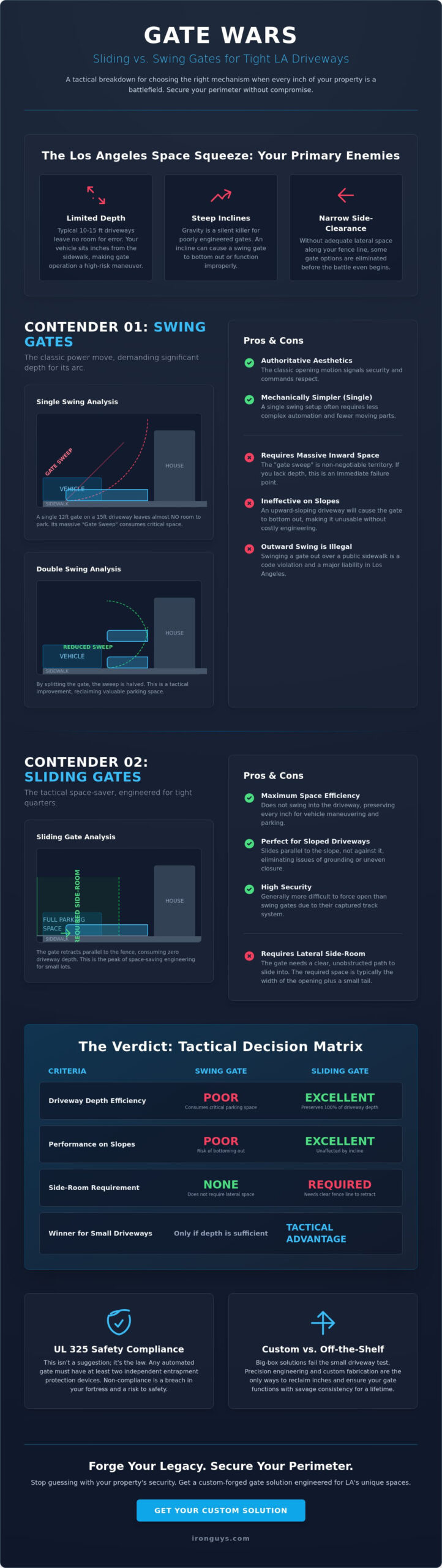
The Verdict: Swing vs. Slide for Your Property
The Iron doesn’t lie. Your property’s footprint dictates your strategy. In the battle of sliding gate vs swing gate for small driveway installations, the winner is decided by the tape measure, not your personal preference. You aren’t just choosing a door; you’re choosing a mechanical partner that must perform under pressure for decades. A swing gate is a classic power move, but if your lot is shallow, it becomes a liability. A sliding gate is a space-hacker, but it requires a clear, linear path along your fence line. The cost of ownership isn’t just the sticker price. It’s the longevity of the motor and the grit of the hardware. While an automated sliding gate might cost 30 to 40 percent more upfront, the space it reclaims on a tight LA lot is often priceless.
Wind resistance is the silent enemy of the swing gate. In a storm, a swing panel acts like a massive sail, putting extreme torque on the hinges and the motor. Sliding gates sit low and anchored, standing tall against the elements without flinching. Maintenance is the discipline that preserves your legacy. Swing gates need hinge lubrication and post alignment to prevent sagging. Sliding gates require a clean track and debris-free rollers to maintain their savage efficiency. If you ignore the grind, the Iron will eventually fail you. Choose the mechanism that fits your lifestyle and your land with uncompromising precision.
Driveway Geometry Checklist
Stop guessing and start measuring. Identify your dead space—the area the gate panel occupies during transit. Then measure your active space—where your vehicle rests. If these two overlap, your design is a failure. Follow the 5-foot rule: never allow your gate to operate within five feet of your vehicle’s bumper. This is your margin for error. It prevents property damage when sensors lag or your focus wavers. Use this simple decision matrix for your sliding gate vs swing gate for small driveway dilemma: Slide if you have lateral width along the fence line; Swing if you have a deep runway behind the entrance.
The Security Showdown
Sliding gates are the warrior’s choice for a reason. They’re structurally superior against forced entry. Because they’re anchored at multiple points along a track or within a cantilever assembly, they don’t yield to a pry bar like a single-point swing latch might. We integrate these masterpieces with custom phone entry systems to ensure you control the perimeter from the palm of your hand. Security is a lifestyle, not an afterthought. You need a system that pairs raw iron strength with elite technology to protect what you’ve built. Don’t settle for a weak link in your fortress.
Forging Your Legacy: The Iron Guys Custom Solution
Retail is a surrender. Those mass-produced, flimsy barriers you see at big-box stores won’t survive the LA grind. We don’t sell products; we forge legacies. A gate is the face of your fortress. It’s the first line of defense. When you’re deciding between a sliding gate vs swing gate for small driveway constraints, you aren’t just looking for a “solution.” You’re looking for an automated masterpiece that commands respect and functions with savage reliability. Mediocrity is the enemy. We destroy it with custom engineering and raw power. Every weld is a commitment to your property’s future.
The Iron Guys process starts with raw, high-gauge steel. We don’t use the thin, hollow tubes found in retail kits. We use the real stuff. Our engineering team analyzes your lot’s geometry. We calculate every pivot point. We account for every load-bearing stress. This isn’t a hobby; it’s a discipline. We integrate security from the ground up, pairing your gate with elite phone entry systems. A gate without a secure entry system is just a heavy ornament. We ensure your perimeter is a closed loop of absolute control. Your security shouldn’t have a weak link.
Custom Fabrication for LA’s Toughest Lots
We thrive where others fail. Hillside homes in the Hollywood Hills or narrow alleyways in Venice demand a different level of grit. We engineer custom solutions that defy standard limitations. Whether it’s a telescoping slide or a bi-folding swing, we maximize your property’s potential. Our horizontal iron works provide a modern, elite aesthetic that signals your status while providing uncompromising security. We utilize high-gauge steel as our non-negotiable standard for every structural component to ensure the Iron never buckles under pressure. Your lot size is a challenge we’ve already solved.
Your Perimeter, Our Mission
Local expertise matters. We know the LA codes. We know the heat. We know the specific security challenges of our urban environment. This isn’t just business; it’s a brotherhood of excellence. When you choose the Iron Guys, you’re joining an elite group of achievers who refuse to settle for average. Waiting to secure your property is a sign of weakness. It’s an invitation to chaos. Take control of your territory. Secure your legacy. Do it now. The Iron is waiting to be forged for you.
Dominate your driveway—get a custom quote from the Iron Guys
Dominate Your Perimeter: The Final Call
You’ve seen the battlefield. You know the stakes. A small driveway isn’t a limitation; it’s a test of your resolve. Choosing between a sliding gate vs swing gate for small driveway layouts comes down to one truth: respect the geometry of your land. Sliding gates hack your space by moving laterally along the fence line. Swing gates command authority but demand a deep, clear runway. Don’t let a weak mechanism or a retail-grade barrier compromise your property’s safety. Mediocrity is a choice you can’t afford to make.
Since 1998, we’ve forged the standard of excellence in uncompromising custom iron fabrication. We specialize in Los Angeles hillside solutions that other installers won’t touch. We don’t do excuses; we do results. Your legacy deserves a perimeter that stands tall and functions with savage consistency. It’s time to move from planning to action and secure what you’ve built with the grit it deserves.
Secure your legacy with a custom driveway gate from Iron Guys. Stop settling for average. Take the first step toward a fortress that reflects your strength. The Iron is ready for you.
Frequently Asked Questions
Is a sliding gate more expensive than a swing gate for a small driveway?
Yes, the initial grind of a sliding gate installation is typically 30% to 40% more expensive than a swing setup. This cost covers the precision hardware, ground tracks, and more complex motor systems required for lateral movement. When comparing a sliding gate vs swing gate for small driveway layouts, you’re paying for the ability to reclaim every inch of your parking area. It’s an investment in your property’s tactical utility and long-term security.
Can I install an automatic gate on a steep LA hillside driveway?
You can absolutely secure a hillside property, but it requires a cantilever sliding system. Standard swing gates will bottom out or strain against gravity on steep inclines, leading to mechanical failure. A cantilever gate floats above the terrain without a ground track, making it the elite choice for LA’s toughest vertical challenges. We engineer these systems to defy gravity and maintain a level perimeter regardless of the slope’s intensity.
How much side room is required for a sliding gate to function?
You need the total width of the driveway opening plus an additional 20% to 30% for the counterbalance and motor clearance. For a standard 12-foot opening, you should have at least 14 to 15 feet of clear fence line to the side. If you don’t have this lateral space, the sliding mechanism will fail your space test. Measure your fence line with total discipline before committing to a sliding design.
What happens if my sliding gate track gets blocked by debris?
Blocked tracks trigger safety sensors and put savage strain on your gate motor. The UL 325 safety standards require these sensors to stop the gate before damage occurs to the mechanism or your vehicle. A disciplined homeowner keeps the “Iron path” clear of LA grit, leaves, and trash. If you ignore the grind of maintenance, you’re inviting a mechanical breakdown that compromises your fortress’s security.
Do swing gates work better with phone entry systems?
Phone entry systems integrate perfectly with both sliding and swing mechanisms. Whether you choose a sliding gate vs swing gate for small driveway security, the digital technology remains the same. You gain total control over your perimeter from your smartphone. This ensures you never have to leave your vehicle to grant access to your brotherhood of guests or trusted delivery drivers. Technology and iron must work as one.
Can the Iron Guys repair a mass-produced gate from a big-box store?
No, we don’t touch mass-produced retail products. Our mission is custom iron fabrication that stands the test of time and commands respect. Retail gates are built with thin, low-gauge materials that lack the grit to survive a high-traffic urban environment. If you want a gate that provides real security and an elite aesthetic, you need a custom-forged solution, not a flimsy barrier from a big-box store.
Which gate type requires the least amount of maintenance in LA’s climate?
Swing gates typically require less daily maintenance because they don’t have a ground track to keep clear of debris. However, they need consistent hinge lubrication to prevent sagging under the weight of heavy, high-gauge iron. Sliding gates demand a clean track but offer superior wind resistance during Santa Ana conditions. Both systems require a professional’s eye to ensure they remain in peak physical condition for decades of service.
Is a double swing gate faster than a sliding gate?
Double swing gates are generally faster because two panels only travel half the distance to clear the driveway opening. This speed is a tactical advantage in high-traffic areas where you need to get off the street quickly. Sliding gates move with a steady, relentless pace but take longer to retract the full width of the panel. Choose the double swing if you demand the quickest entry without sacrificing the structural strength of your iron perimeter.