
Your perimeter is only as strong as the sensors guarding it. If your gate is ghosting or cycling randomly, your security is a liability. A malfunctioning sensor isn’t a minor glitch; it’s a breach in your armor that leaves your property exposed to the world. You need an automatic gate safety sensor adjustment that turns your hardware back into an uncompromising shield. Stop guessing and start calibrating. Mediocrity in your security setup is the primary enemy of a truly protected estate.
We understand the frustration of fighting dust, heat, and sensors that refuse to cooperate. It’s time to move from complacency to decisive action. You will learn to master the precision of sensor calibration to ensure your gate operates with surgical accuracy. We’re diving into the grit of UL 325 safety standards, including the March 2025 updates, and the dual safety requirements of ASTM F2200. This is how you eliminate false reversals and lock down your perimeter with the authority your property demands.
Key Takeaways
- Identify the root cause of “gate ghosting” to kill the reversal loop that leaves your perimeter exposed.
- Master the distinction between infrared photo-eyes and internal sensitivity to ensure your hardware’s eyes never blink.
- Execute a precise automatic gate safety sensor adjustment using our 5-step field guide to restore surgical signal strength.
- Implement the “Clean and Clear” protocol to shield your electronics from the relentless grind of dust and environmental heat.
- Recognize the critical threshold where a failing circuit board demands professional reinforcement to maintain UL 325 compliance.
Stop the Ghosting: Why Your Gate Sensors Are Failing
Your gate sensors are the only thing standing between a secure perimeter and a liability nightmare. They are the eyes of your system. When those eyes go blind, your security collapses. You hit the remote, expecting a solid seal of iron, but the gate stutters and reverses. This is “ghosting.” It isn’t a mystery; it’s a failure of discipline. This reversal loop happens because the system detects a phantom threat. It refuses to close when you need it most, leaving your property vulnerable to anyone walking off the street.
Distinguishing between a physical obstruction and a calibration error is the first step toward dominance over your hardware. A rock in the track is an easy fix. A misaligned beam is a technical challenge. If you ignore the signs, you’re killing your equipment. Constant, violent reversals put massive mechanical stress on your operator. You wouldn’t redline your truck in park; don’t let a bad sensor grind your motor into dust. A precise automatic gate safety sensor adjustment is the only way to protect your investment and maintain your shield.
This standard of protection is universal. Whether you are maintaining a driveway gate or evaluating dvižna garažna vrata cena for a high-performance garage system, the integration of top-tier safety sensors is non-negotiable for property security.
To ensure your overhead systems meet these rigorous standards, Aero Garage Doors LLC delivers professional garage door installation and 24-hour repair services designed for uncompromising safety and precision.
The UL 325 Standard: Non-Negotiable Safety
Safety isn’t a suggestion. It’s a mandate. The UL 325, 7th Edition standard has governed every operator manufactured since August 1, 2018. As of March 2025, these regulations are even tighter, requiring specific provisions for bifold gates and clearer injury warnings. You must have two independent safety points: inherent sensors inside the motor and external sensors like photo-eyes. Bypassing these features is a recipe for legal ruin. If your gate fails and hurts someone, a bypassed sensor is an admission of guilt. Follow the Electric Gate Safety guidelines to ensure your system remains a fortress, not a lawsuit. Compliance is the baseline for excellence.
Signs Your Sensors Need Immediate Discipline
Your gate communicates through movement and light. Watch for the stutter. If the gate starts to close and then jerks back immediately, your sensors are screaming for help. Don’t ignore the control board. Modern systems from Liftmaster or Apollo use LED diagnostic codes to tell you exactly where the failure lies. In the harsh environment of LA, your sensors are under constant assault. Dust, smog, and even spiderwebs can break the infrared beam. This environmental debris mimics a solid object, forcing the gate into a defensive loop. Clean the lenses. Clear the path. Demand excellence from your hardware. If the signal is weak, the system fails. There is no middle ground in security.
The Anatomy of Detection: Photoeyes vs. Sensitivity
Detection is binary. Either your system sees the threat, or it doesn’t. To master an automatic gate safety sensor adjustment, you must understand the two-layer defense protecting your property. First, you have the photoelectric sensors. These are the “eyes” that project an invisible infrared beam across your driveway. Second, you have internal obstruction sensing. This is the “muscle memory” of the operator. It measures the resistance the motor encounters. If either system reports a conflict, the control board kills the movement. It’s a high-stakes conversation between hardware and software happening in milliseconds.
Heavy iron gates are not mass-produced toys. They carry massive kinetic energy. A lightweight retail gate might stop with a gentle nudge, but a custom driveway gate requires a specific sensitivity profile. The control board is the commander. It receives the “stop” or “reverse” command from the sensors and executes it instantly. If your sensors are misaligned, the beam breaks for no reason. The gate reverses. Your security is compromised. Adhering to Automated Gate Operator Safety Standards is the only way to ensure these two systems work in a perfect, disciplined harmony against accidents.
Photoelectric Sensors (Photoeyes)
Retro-reflective sensors use a single unit and a mirror. They’re cheap. They’re lazy. They fail when fog or dust hits the reflector. Through-beam sensors use a dedicated sender and receiver. This is the standard for any serious installation. One side fires the infrared light; the other catches it. If that connection breaks, the gate halts. In custom ironwork, mounting these is a battle. Installers often slap them on flimsy brackets that vibrate. A vibrating sensor is a failing sensor. Secure your mounts to the masonry or the heavy steel posts. If you want a perimeter that holds, start with professional-grade automatic gates that don’t compromise on mounting integrity.
Internal Obstruction Sensitivity
Internal sensing is your last line of defense. The operator monitors the amperage draw or RPMs of the motor. When the gate hits something, the “force” spikes. Digital sensitivity is the modern warrior’s choice. It allows for surgical precision compared to the crude mechanical clutches of the past. Old clutches slip and wear out. Digital systems stay sharp. Never set your sensitivity too low on a heavy gate. If the motor has to fight a poorly calibrated sensor, it will burn out. You want the gate to move with authority but stop the moment it meets resistance. That balance is the hallmark of a disciplined system.
Troubleshooting the Grind: Alignment vs. Calibration
Stop wiggling the hardware. If your gate is ghosting, it is a test of your discipline. In Los Angeles, the environment is a constant adversary. Smog, coastal salt, and relentless dust create a film on your lenses that kills the signal. Before you touch a single screw for an automatic gate safety sensor adjustment, execute the ‘Clean and Clear’ protocol. Use a non-abrasive microfiber cloth. Wipe the lenses. Clear the brush. If the ghosting persists, you aren’t looking at a dirty lens; you’re looking at a systemic failure. You must decide if the beam is misaligned or if the pulse of the system has flatlined.
Verification is the final stage of the grind. Use the cardboard test for absolute certainty. Place a solid object between the sensors while the gate is in motion. The system must react instantly. If the gate continues to grind forward, your adjustment was a failure. There is no room for “good enough” when your property is on the line. Adhering to automatic gate safety standards requires this level of uncompromising detail to prevent entrapment and protect lives.
Precision Alignment Techniques
Precision is the only standard. Use a laser level. Across a twenty foot driveway, a fraction of a degree off at the sender means a total miss at the receiver. When dealing with custom iron pillars, do not strip the metal. Adjust the brackets with intent. In the high LA sun, infrared wash-out is a common enemy. The sun can overpower the sensor’s own beam, tricking the system into a permanent “obstructed” state. Secure a sun shield over the receiver. It is a simple, gritty fix that separates elite perimeters from amateur setups. Move with purpose. Lock the brackets down once the signal is green.
Wiring and Voltage Integrity
Don’t assume it is the beam. Check the pulse of the machine. Rodents in the hills love the taste of wire insulation. Frayed wires are a death sentence for signal integrity. Grab a multimeter. Verify you have a clean 12V or 24V DC signal at the sensor head. If the voltage drops, your sensor will brown out and trigger a random reversal. Open the main control board. Tighten every terminal block. A loose wire is a lazy mistake that compromises your entire security shield. Eliminate the variables. Ensure the power is consistent before you blame the alignment.
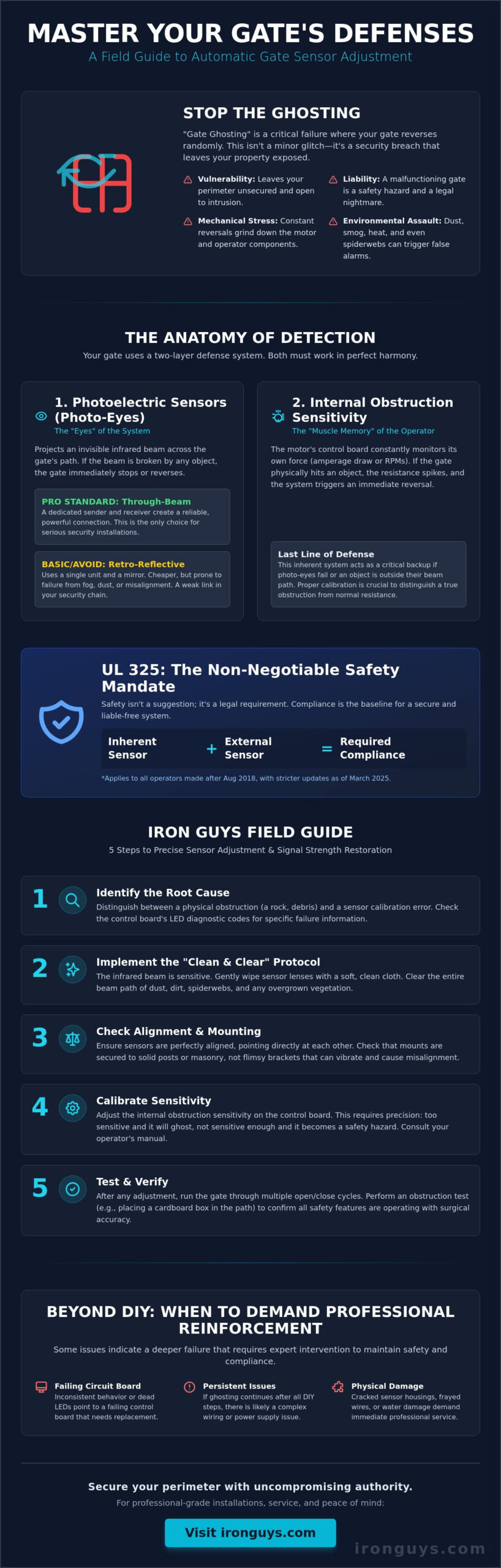
Iron Guys Field Guide: 5 Steps to Precise Sensor Adjustment
Precision is a sequence. You don’t just “fix” a gate; you engineer a solution. Follow this field guide to reclaim control of your perimeter. First, shift your operator into manual mode. This is non-negotiable. It prevents accidental activation while you’re working in the “red zone” near the drive chain. Second, clean the lenses with a non-abrasive microfiber cloth. LA smog is a physical barrier that weakens the infrared pulse. Restore the signal strength before you touch the electronics. Third, execute the physical alignment. Loosen the mounting brackets, find the sweet spot where the diagnostic LED stays solid, and lock it down. If that light flickers, your perimeter is still weak.
Fourth, move to the control board for the automatic gate safety sensor adjustment of the force settings. This isn’t about raw power; it’s about calibrated resistance. Fifth, run the final stress test. Observe a full opening and closing cycle. Listen for the motor’s rhythm. Watch for the stutter. If the gate moves with surgical precision, you’ve earned your security. If you want a system that never flinches, invest in professional automatic gates built for high-performance durability. Excellence is the only standard we recognize.
Digital Board Calibration
Modern Liftmaster and Elite operators demand technical respect. Navigate the digital menu to find the “Learn” mode. This isn’t a suggestion; it’s a requirement for the board to calculate the specific mass of your ironwork. The system runs a test cycle to measure the force needed to move the gate. Once learned, fine-tune the reversal delay. You want a gate that stops instantly upon contact, not one that slams and bounces. A well-calibrated board is the brain of your fortress. It ensures your hardware remains an uncompromising shield against accidents and intruders alike.
The Safety Reversal Test
Test your work against reality. Place a standardized object, like a 2×4, in the path of the closing gate. Never use your body as a sacrificial lamb. The gate must detect the object, stop, and reverse within two seconds of contact. This is the UL 325 standard in action. Document this test. Keep a log for your property management records. In the eyes of the law, if it isn’t documented, it didn’t happen. Compliance is your shield against liability and failure. Don’t settle for “functional” when you can achieve absolute safety.
Beyond DIY: When Your Security Demands Professional Reinforcement
Know your limits. There is a point where the grind of DIY troubleshooting hits a wall. If you have executed every step of the automatic gate safety sensor adjustment and the system remains unresponsive, the core is likely compromised. A fried circuit board is a silent failure. No amount of lens cleaning or bracket tightening will resurrect a dead processor. This is the moment to admit your perimeter needs expert intervention. Swapping a main control board isn’t a weekend project; it is technical surgery that requires re-mapping travel limits and force profiles from scratch.
Never fall for the temptation to bypass your sensors. It is a failure of character and a massive legal liability. Bypassing safety loops turns your driveway gate into a blind, crushing force. We don’t compromise on safety, and neither should you. A bypassed system is an invitation for catastrophe. When the electronics fail, you don’t cut the wires; you rebuild the system. Elite security demands a system where every sensor, motor, and phone entry system operates in a perfect, disciplined loop of communication.
Custom Iron Integration
High-performance architectural iron works require a level of integration that off-the-shelf retail products cannot achieve. We don’t just bolt sensors to the surface where they can be kicked or knocked out of alignment. We weld custom, tamper-proof housings directly into the bespoke ironwork. This creates an armored shell for your sensors that withstands both the elements and physical tampering. We conceal all wiring within the iron tubing itself. This prevents rodents from chewing through your signal lines and maintains a clean, professional aesthetic that reflects the value of your property. We engineer every gate to ensure that artistic flourishes never create “blind spots” in your infrared field.
The Elite Maintenance Protocol
Mediocrity is the primary enemy of a secure estate. High-value properties in Los Angeles demand an uncompromising maintenance standard. An annual professional inspection is the only way to ensure your hardware remains a shield rather than a hazard. Our approach is different. We don’t just “fix” a broken part; we forge the entire system to last. We stress-test the synergy between your automatic gates and your intercom sistems to ensure your perimeter is a total fortress. Stop tolerating a gate that stutters or fails when you need it most. Lock down your gate security with an Iron Guys inspection and demand the excellence your property deserves. Every moment you wait is an opportunity for failure. Act now.
Secure Your Fortress: Demand Precision Now
Your perimeter is a direct reflection of your discipline. A stuttering gate isn’t just a technical nuisance; it’s a crack in your armor. You’ve learned that mastering an automatic gate safety sensor adjustment is the difference between an uncompromising shield and a liability trap. We’ve explored the grit of alignment, the necessity of UL 325 compliance, and the environmental war against LA dust. Don’t let your security degrade into mediocrity. Every moment your sensors are out of sync is a moment your property is exposed.
Since 1998, we’ve forged high-performance systems that withstand the grind of the real world. We are specialists in custom-fabricated, tamper-proof sensor housings that ensure your “eyes” never blink. If your hardware is failing the stress test, it’s time for professional reinforcement. Don’t settle for “functional” when you can achieve absolute dominance over your property’s entry points.
Demand Excellence. Get Your Gate Inspected by Iron Guys.
Take command of your property today. Lock down the perimeter and ensure your gate operates with the surgical precision it was designed for. Stay sharp. Stay secure.
Frequently Asked Questions
Why does my automatic gate open back up as soon as it closes?
Your gate is trapped in a reversal loop because the safety circuit is broken. The system detects a phantom obstruction and defaults to a fail-safe open position. This is usually caused by misaligned photo-eyes, dirty lenses, or environmental debris. Clear the path and check your sensor alignment to stop the ghosting and reclaim your security.
How do I know if my gate sensors are aligned correctly?
Check the diagnostic LED indicators on the sensor heads for immediate verification. A solid, unwavering light signals a locked connection between the sender and receiver. If the light flickers or changes color, your signal is weak. Use a laser level to ensure the beam is perfectly parallel across the driveway for an uncompromising perimeter.
Can I bypass my gate safety sensors if they are broken?
Never bypass your safety sensors. Doing so is a failure of character and a violation of UL 325 safety standards. You turn your driveway gate into a blind, crushing weapon that creates massive legal liability. If the sensors fail, repair the hardware. Do not compromise the safety of your property for a temporary fix.
How does the Los Angeles weather affect my gate sensor performance?
LA smog and dust create a physical film on your lenses that kills signal integrity. Intense sunlight can also cause infrared washout, tricking the receiver into sensing a permanent obstruction. This environmental grind makes a regular automatic gate safety sensor adjustment essential to overcome the heat and coastal salt that degrade your electronics.
What is the “cardboard test” for automatic gate safety?
The cardboard test is a raw verification of your system’s defensive response. Place a solid object in the gate’s path during the closing cycle to simulate an obstruction. The gate must detect the object and reverse within two seconds. If the gate grinds forward, your calibration is a failure and requires immediate professional reinforcement.
How often should I adjust the sensitivity on my gate opener?
Perform a diagnostic check every six months or after any extreme weather shift. Your automatic gate safety sensor adjustment should account for ground shifting or hardware expansion caused by the high LA sun. Routine discipline prevents the mechanical stress that leads to total operator failure. Don’t wait for a breakdown to act.
Does a custom iron gate require special safety sensors?
Bespoke ironwork requires sensors that meet the strict UL 325, 7th Edition mandates for entrapment protection. Because heavy iron carries significant kinetic energy, you must install at least two independent safety devices per zone. We use high-performance through-beam sensors and tamper-proof housings to ensure your custom gate remains a secure, compliant fortress.