
A fence that looks good on day one but rusts through by year three isn’t an investment; it’s a liability. In a country where a home break-in occurs every 26 seconds, your perimeter needs to be more than just decorative. Most homeowners struggle when choosing an iron fence contractor because the Los Angeles market is flooded with retail installers posing as master craftsmen. You deserve a heavy-duty, custom-fabricated solution that stands up to the salty coastal air and provides real security for your family.
We understand the anxiety of hiring a “cowboy” contractor who might cut corners or disappear mid-project. This no-nonsense guide for 2026 will teach you how to distinguish genuine fabricators from those just bolting together pre-made panels. You’ll learn the vital questions to ask about Los Angeles permit requirements, HPOZ regulations, and automatic gate integration. We’ll show you how to spot high-quality craftsmanship that increases property value and provides long-term peace of mind. By the end of this article, you will have the local expertise needed to hire a professional who handles everything from the first weld to the final intercom sync.
Key Takeaways
- Learn the critical difference between retail installers and custom fabricators to ensure your fence is built for security rather than just decoration.
- Discover how to verify essential C-23 or C-13 licenses and professional insurance when choosing an iron fence contractor in the Los Angeles area.
- Identify why a single-source contractor for both iron fabrication and automatic gate integration provides a more reliable and secure perimeter.
- Master the five key questions to ask during a consultation, including shop-welding practices and specific rust-prevention methods for coastal climates.
- Understand the long-term financial benefits of custom ironwork, from higher property resale value to significantly lower maintenance costs over twenty years.
Fabricator vs. Installer: The First Cut in Choosing an Iron Fence Contractor
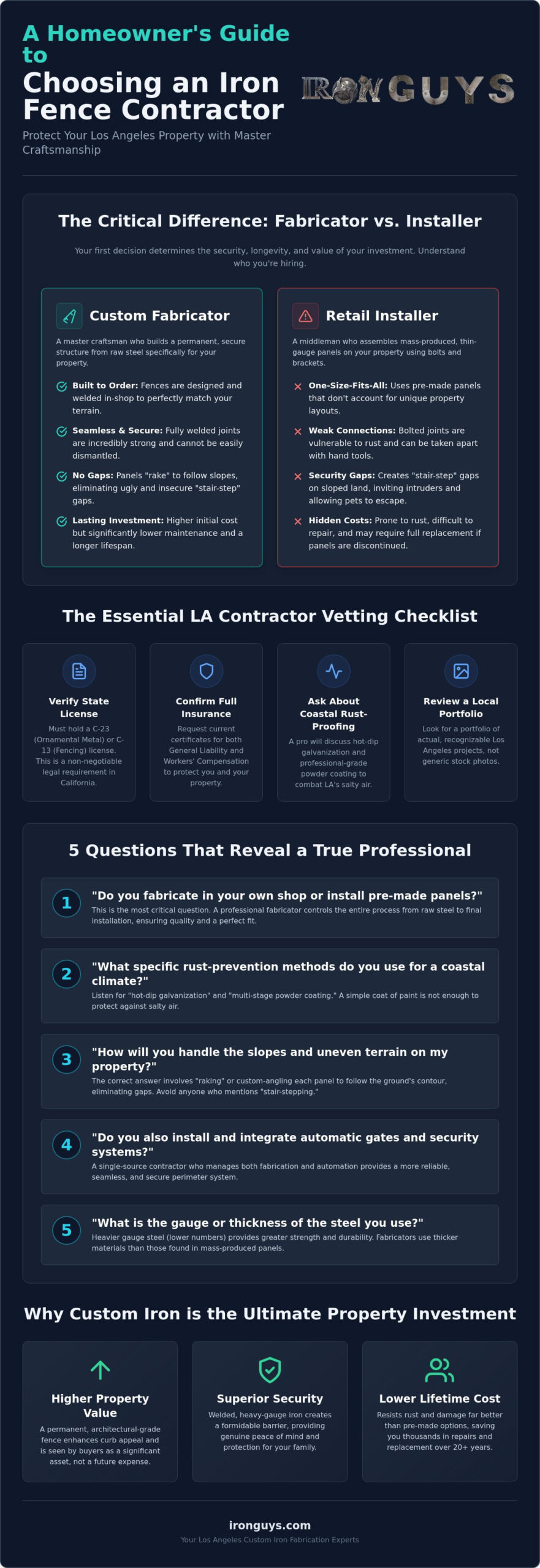
Most property owners assume that every fence company builds their own product from scratch. That’s a dangerous mistake. When you start the process of choosing an iron fence contractor, you’ll quickly find two very different types of businesses: retail installers and custom fabricators. An installer is essentially a middleman with a drill. They buy mass-produced, thin-gauge panels from a warehouse and bolt them together on your property. If your lot isn’t perfectly flat, these panels leave “stair-step” gaps at the bottom that look cheap and invite intruders.
A custom fabricator is a master craftsman who manages the entire process in-house. They don’t buy kits; they buy raw steel. Every joint is welded in a controlled shop environment, and every panel is designed to follow the specific contours of your land. This is especially critical in Los Angeles, where hillside lots and uneven terrain are the norm. A fabricated fence “rakes” to the angle of your slope, ensuring a seamless, secure perimeter without ugly gaps. While the history of wrought iron is rooted in hand-forged artistry, modern fabrication combines that legacy with high-tech precision to create a structure that lasts a lifetime.
The Hidden Cost of Pre-Made Panels
Retail systems rely on bolts and brackets to stay upright. These connection points are the first places where rust takes hold, especially in our salty coastal air. Once the factory finish is broken by a bolt, moisture gets inside the tube and eats the metal from the inside out. Mass-produced components are also notoriously difficult to repair. If a car hits a retail fence five years from now, you might find that the manufacturer has discontinued that specific panel style, forcing you to replace the entire line rather than just one section.
Why Fabrication Matters for Security
Security isn’t just about looking tough; it’s about structural integrity. A custom-fabricated fence features seamless welds that are nearly impossible to pry apart. Unlike bolted systems that can be dismantled with basic hand tools, a welded iron fence is a singular, solid unit. Fabrication also allows for:
- Custom Gap Spacing: We can reduce the distance between pales to prevent small pets from escaping or intruders from getting a foothold.
- Integrated Hardware: Heavy-duty hinges for automatic gates are welded directly to the posts, preventing the “gate sag” common with bolt-on alternatives.
- Variable Heights: We can adjust the height of specific sections to meet Los Angeles city codes while still maximizing your privacy.
Choosing an iron fence contractor who understands the physics of a weld ensures your property is protected by a fortress, not a kit. A professional fabricator treats your fence as a permanent architectural feature, ensuring the joints are as strong as the iron itself.
Vetting for Mastery: The Essential Los Angeles Contractor Checklist
Vetting isn’t just about price. It’s about protection. In California, you must check a contractor’s license before signing anything. Specifically, look for a C-23 Ornamental Metal license or a C-13 Fencing license. These aren’t suggestions. They’re legal requirements that prove the contractor has met state standards for trade knowledge and safety. Choosing an iron fence contractor who operates without these credentials puts your property and your wallet at risk.
Insurance is the next non-negotiable. General liability protects your home if a welder accidentally sparks a fire during installation. Workers’ compensation protects you from personal liability if a crew member is injured on your property. If a contractor can’t produce current certificates for both, show them the door. A “cheap” bid often means they’re skipping these critical protections. Choosing an iron fence contractor requires a deep dive into their local track record and their commitment to legal compliance.
LA’s salt air is a silent killer for iron. Ask your potential contractor about the “Coastal Test.” A professional should discuss hot-dip galvanization and professional-grade powder coating. These processes create a barrier that prevents rust from eating your investment from the inside out. Also, scrutinize their portfolio. If the photos look like generic stock images, they probably are. Look for recognizable LA streets or specific architectural styles like Spanish Revival or Mid-Century Modern to prove they’ve actually worked in our neighborhoods.
Navigating Los Angeles Building Codes
Los Angeles has strict rules that vary by neighborhood. Front yard fences are generally capped at 3.5 feet, while rear yards can often go up to 8 feet depending on your specific zone and lot width. Pool safety is another hurdle. Security iron fences for pools must have specific gap widths (usually under 4 inches) and self-closing, self-latching gates to pass inspection. If you’re building on a hillside, you need a contractor who understands the hillside ordinance. Heavy iron requires deep, reinforced concrete footings to prevent the structure from shifting during seismic events or soil expansion.
Local Experience and Reputation
National chains don’t understand our expansive clay soil or the micro-climates of the San Fernando Valley versus the Westside. A local expert has references you can actually drive by and see. Look for fences that have survived 10 or 20 years without sagging or peeling. Finally, demand to see their physical shop. A real fabricator has a local address with welding bays and heavy machinery. If they only have a truck and a cell phone, they’re likely a retail installer, not a craftsman. You can see the difference in quality by viewing our own architectural iron works gallery to see how we handle local LA challenges.
Security Integration: Can They Handle More Than Just the Iron?
A physical barrier is only half the battle. In modern Los Angeles, true property protection requires a seamless blend of heavy-duty iron and sophisticated electronics. When choosing an iron fence contractor, you need a team that understands how a 500-pound gate interacts with a high-torque motor. Hiring one company for the iron and another for the automation is a recipe for disaster. If the gate fails, the iron guy will blame the motor, and the motor guy will blame the gate. You want a single point of accountability.
Security iron fences require a different level of structural reinforcement compared to standard decorative panels. Because they often house automatic gates and electronic locks, the posts must be anchored with deeper, reinforced concrete footings. This prevents the “gate sag” that can misalign magnetic locks or cause motor strain. We’ve seen countless DIY or retail-grade installs fail because the footings couldn’t handle the constant vibration and weight of a moving security gate. A professional contractor ensures the foundation is as strong as the iron it supports.
The Automatic Gate Factor
Automated gates are heavy machinery. They require precise mechanical alignment and strict adherence to automated gate safety standards like UL 325. This regulation ensures the gate has proper sensors and entrapment protection to prevent injury. When choosing an iron fence contractor, ask if they specialize in both sliding and swinging gate motors. A sliding gate is often better for steep LA driveways where a swinging gate would bottom out. Your contractor should be able to troubleshoot the mechanical hinge and the electrical circuit board with equal expertise.
Access Control and Intercom Systems
Modern security is about convenience and visibility. We integrate phone entry systems that allow you to see visitors and open your driveway gates from your smartphone, whether you’re in the kitchen or out of town. For multi-family properties, we install apartment intercoms that handle high-volume traffic without glitching. The ironwork must be designed from the start to house these intercoms and sensors securely. This means welding custom mounting plates and internal wire chases directly into the posts. This level of integration keeps your hardware safe from tampering and protects the wires from the elements, ensuring your security system actually works when you need it most.
The Consultation: 5 Questions That Reveal a Pro Contractor
The consultation is your best chance to separate the experts from the amateurs. Most people focus on the final price, but the technical details determine if that price is actually a bargain. When choosing an iron fence contractor, you need to dig into their specific shop process. Start by asking if they weld on-site or in a shop. A master fabricator does the heavy lifting in a controlled shop environment. This allows for cleaner welds and a superior finish that on-site welding just can’t match. On-site work should be reserved for final fitment and minor adjustments only.
Ask specifically about their coastal protection strategy. If they just say “we paint it,” keep looking. In Los Angeles, you want to hear about hot-dip galvanizing and professional powder coating. This prevents the salty air from turning your security fence into a pile of rust within three years. You should also ask how they prevent gate sag over time. A pro will talk about reinforced posts and heavy-duty adjustable hinges that can be tuned as the gate settles. Finally, confirm if they are licensed to handle your phone entry systems and automatic gates themselves. You don’t want a contractor who subs out the most complex part of the job to an unknown third party.
Spotting the Red Flags
Contractors who demand 100% payment upfront are a major risk. In California, there are strict limits on down payments for home improvement projects. Another warning sign is vague language about materials. If they can’t tell you the exact gauge (thickness) of the iron or if they use “commercial grade” as a catch-all term, they’re likely hiding low-quality materials. Finally, a lack of a written warranty for both the structural welds and the finish is a dealbreaker. If they don’t stand behind their work for at least a few years, you shouldn’t either.
Green Lights: Signs of a Master Craftsman
A true professional provides more than just a quote; they provide a plan. Look for contractors who offer detailed CAD drawings or sketches of the custom design. This ensures everyone is on the same page before the first piece of iron is cut. They should also be able to explain exactly how they will secure posts in your specific soil, whether it’s the hard-packed dirt of the Valley or a loose hillside in the Canyons. A transparent timeline that accounts for the time needed for fabrication and the proper curing of finishes is a sign of a well-run operation. If you’re ready to see what a professional shop looks like, contact Iron Guys for a consultation and let’s discuss your project.
Why Custom Iron is the Ultimate Investment for Your Property
Custom iron isn’t just a boundary; it’s an architectural signature that defines your property’s character. While the initial cost of bespoke fabrication is higher than retail alternatives, the long-term value is unmatched. A high-quality, architecturally appropriate iron fence can yield a 45% to 70% return on investment by significantly boosting curb appeal and resale value. In the competitive Los Angeles real estate market, a secure, hand-welded perimeter serves as a powerful selling point that mass-produced panels simply cannot replicate.
Durability is where the real savings happen. When choosing an iron fence contractor who prioritizes high-grade materials and proper finishing, you’re buying a product designed to last 50 years or more. Cheap retail systems often require replacement or major repairs within a decade due to structural failure or deep-seated rust. Quality ironwork requires minimal maintenance beyond occasional cleaning and touch-ups. By investing in craftsmanship upfront, you avoid the cycle of constant repair costs that plague lower-quality installations.
Custom Aesthetics for Modern LA Homes
Modern Los Angeles architecture demands clean lines and sophisticated profiles. We’ve seen a massive surge in demand for horizontal iron works, a trend that makes smaller yards appear wider and complements the minimalist aesthetic of Hollywood Hills and Westside estates. To create a cohesive look, many homeowners choose to match their security fence with custom stair railings, balcony railings, or window guards. This unified approach to architectural iron works ensures that your security features look like an intentional part of the home’s design rather than an afterthought.
Finalizing Your Decision
Settling for the lowest bid is often the most expensive mistake a property owner can make. A low price usually indicates a contractor who is cutting corners on steel gauge, skipping the galvanization process, or using unlicensed labor for complex automatic gate integrations. You deserve the peace of mind that comes from working with a trusted local authority. At Iron Guys, we’ve been forging security and style in Los Angeles since 1998. We handle every detail in-house, from the first weld to the final programming of your phone entry systems.
Ready to secure your property with a fence that lasts a lifetime? Contact Iron Guys for a custom consultation today.
Take the Next Step Toward Uncompromising Security
Your property’s perimeter is its first and most important line of defense. Throughout this guide, we’ve explored why the technical details of shop-fabrication and the rigor of local licensing are non-negotiable. Don’t settle for a retail installer who simply bolts together pre-made panels. Instead, prioritize a custom fabricator who understands the unique hillside and coastal challenges of the Los Angeles landscape. Choosing an iron fence contractor is a decision that impacts your home’s safety and resale value for the next twenty years.
A truly secure perimeter requires a partner who can integrate heavy-duty ironwork with advanced automatic gates and phone entry systems. Since 1998, Iron Guys has operated as a family-owned business of local artisans dedicated to protecting our community. We handle every weld in-house to ensure your investment stands up to the elements and provides the durability you deserve. You’ve done the research and you know exactly what to look for in a master craftsman.
Secure your property with a custom iron solution from the Los Angeles experts.
Now is the time to build a perimeter that provides both high-end aesthetics and absolute peace of mind for your family.
Frequently Asked Questions
How do I choose between a custom iron fence and a pre-made retail panel?
Custom fabrication is the only way to ensure a perfect fit for your specific property line. Retail panels are mass-produced in fixed dimensions, which often results in awkward gaps or “stair-stepping” on Los Angeles hillsides. When you are choosing an iron fence contractor, look for a team that builds from raw steel. This allows for seamless welds and a structure that is far more difficult for intruders to dismantle compared to bolted retail kits.
What is the best way to prevent rust on an iron fence in Los Angeles?
Hot-dip galvanization is the most effective way to prevent rust in our coastal environment. This process involves dipping the iron in molten zinc to create a permanent protective barrier. When combined with a high-quality powder-coated finish, your fence can withstand the salty air for decades without corroding from the inside out. Don’t settle for standard spray paint, which chips easily and requires constant touch-ups in the LA sun.
Do I need a special permit for an iron fence in LA?
You generally need a building permit for any fence over 3.5 feet in a front yard or 8 feet in a side or rear yard. Los Angeles building codes are strict about height and visibility, especially on corner lots near intersections. We recommend verifying specific zoning requirements for your neighborhood. Historic Preservation Overlay Zones (HPOZ) often have even more detailed restrictions on materials and design that require additional board approval.
Can an iron fence contractor also install my automatic driveway gate?
Yes, a professional contractor should handle both the ironwork and the electronic access systems. When choosing an iron fence contractor, prioritize those who have experience with automatic gates and phone entry systems. This ensures the gate frame is engineered to handle the torque of the motor. Having one team manage the fabrication and the electronics prevents compatibility issues and provides a single point of contact for future service.
What is the difference between wrought iron and ornamental iron?
True wrought iron is a specific material that is hand-forged by blacksmiths, while modern “ornamental iron” is typically made from high-strength steel or iron alloys. Most modern “wrought iron” fences in Los Angeles are actually ornamental steel. It offers the same classic aesthetic but provides better durability and more consistent weld points for modern security applications. This material is much better suited for the heavy-duty demands of automatic gates.
How long should a custom-fabricated iron fence last?
A custom-fabricated iron fence should last at least 50 years if it is manufactured and installed correctly. The longevity of the structure is determined during the fabrication stage by the quality of the welds and the rust-prevention coating. Choosing an iron fence contractor who specializes in hot-dip galvanization is the best way to ensure your perimeter remains a permanent asset to your property rather than a temporary fix that fails within a decade.
What should I look for in an iron contractor’s portfolio?
Look for photos of completed projects in neighborhoods similar to yours to verify their local expertise. Pay close attention to the quality of the welds and how the fence handles slopes or curved walls. A strong portfolio should showcase complex installations like automatic gates and integrated intercom systems rather than just simple, flat-ground projects. Ask to see fences they installed ten years ago to see how the finish has held up.
How much maintenance does a custom iron fence really require?
Custom iron requires very little maintenance once it is properly galvanized and powder-coated. You should wash the fence with mild soap and water once or twice a year to remove salt and dirt buildup. Periodically check the hinges on your automatic gates for lubrication needs, but the iron itself should remain maintenance-free for years if the finish remains intact. If you notice a deep scratch that reaches the metal, touch it up quickly to prevent oxidation.