
A custom sliding gate is only as reliable as the concrete and code it’s built on. Your Los Angeles driveway gate is a heavy-duty piece of machinery, not just a decorative fence. Most property owners assume the biggest challenge is the design, but the real work happens underground and in the control box. If the foundation is off by an inch or the motor is underpowered, that custom ironwork becomes a liability that jumps the track. Understanding the professional automatic slide gate installation process is the only way to ensure your investment actually protects your home.
It’s natural to worry about complex motor types or failing a city inspection. You want a secure, smooth-operating entrance that integrates with your smartphone, not a project that gets bogged down in permit delays. We’re going to show you exactly how to master the technical steps and security requirements for your property. This guide walks through the essential 2026 California safety standards, including AB 2149 compliance and UL 325 updates, so you can vet your contractor with total confidence.
Key Takeaways
- Precision site planning prevents track failure. Learn why identifying property lines and drainage patterns is non-negotiable before excavation begins.
- Choose the right mechanism for your landscape. We break down when to use a V-Track system and when a floating cantilever gate is the better solution.
- Master the automatic slide gate installation process. Understand how custom-fabricated iron is mounted and paired with a high-performance operator for maximum durability.
- Upgrade your security with modern electronics. Learn the technical requirements for wiring motor operators and integrating smartphone-controlled entry systems.
- Prioritize safety and compliance. Get the facts on 2026 California standards, including UL 325 requirements and mandatory entrapment protection devices.
Site Preparation and Planning: The Foundation of Security
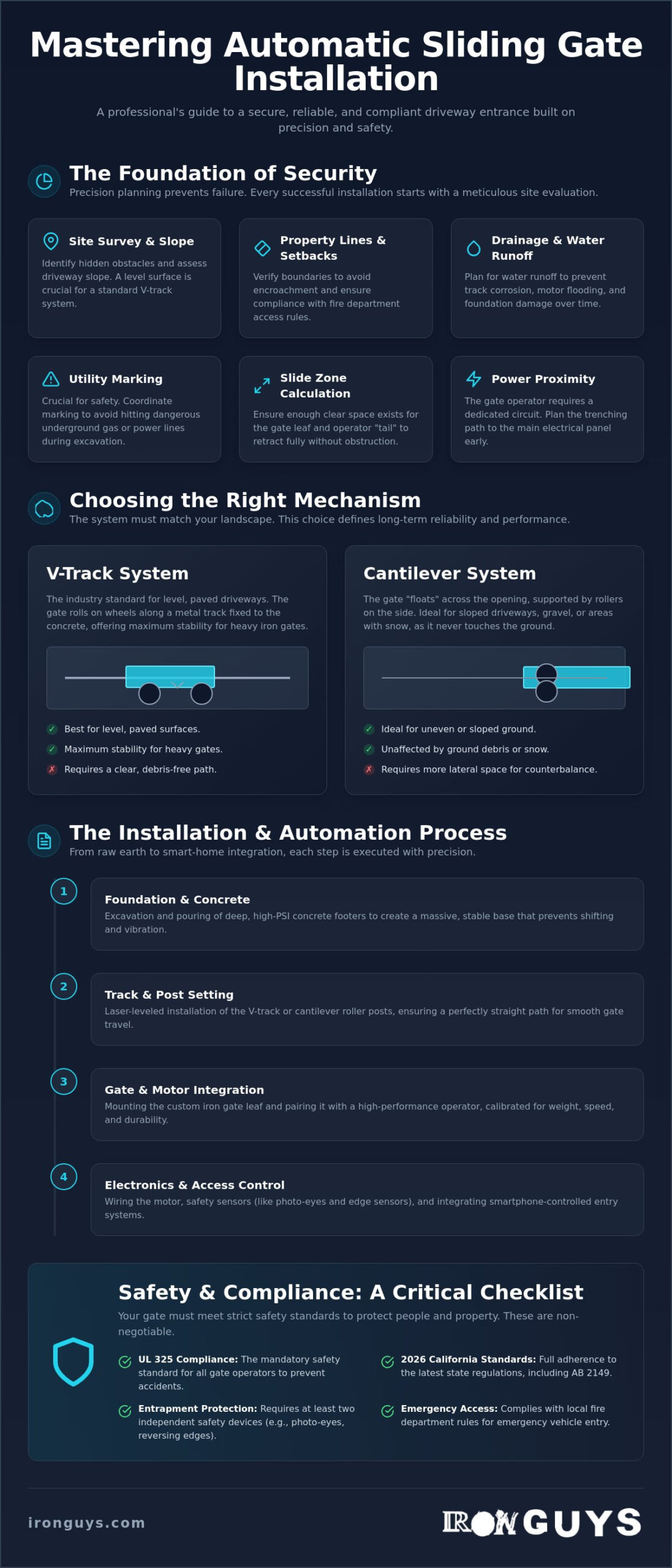
Precision starts before the first shovel hits the dirt. A professional site survey identifies hidden obstacles that could derail the project later. We look at the slope of your driveway; a slide gate requires a level surface or a specialized cantilever setup to function without straining the motor. We also verify property lines to ensure your gate doesn’t encroach on city land or a neighbor’s yard. Drainage is equally vital. Standing water is the enemy of iron and electronics alike. Every automatic slide gate installation process must account for water runoff to prevent track corrosion or motor flooding.
Before any excavation begins, we coordinate utility marking. In Los Angeles, hitting a gas line or an underground power cable isn’t just a delay; it’s a dangerous and expensive mistake. We also calculate the “slide zone.” This is the total clear space required for the gate leaf to retract fully. You need enough room for the gate plus the “tail” of the operator. If a tree or a retaining wall is in the way, the design must change before fabrication starts. Finally, we map out power proximity. Your gate operator needs a dedicated electrical circuit, so we determine the trenching path to your main panel early to avoid surprises.
Soil Stability and Concrete Foundation
Soil stability varies wildly across LA, from the rocky hillsides of Bel Air to the sandy flats of the Westside. We engineer concrete footers that go deep enough to prevent shifting during seasonal soil expansion. For a heavy, custom-fabricated iron electric gate, we use high-PSI concrete to create a massive, stable base. This foundation supports the weight of the gate leaf and keeps the V-track perfectly aligned. Setting anchors while the concrete is fresh ensures a permanent, vibration-free mount for the motor and track assemblies.
Navigating Los Angeles Permits and Codes
Navigating the 2026 Los Angeles County Building Code is a technical hurdle. Most residential front yard gates are limited to six feet in height, though specific hillside ordinances may vary. We also ensure your gate setback complies with fire department access rules, allowing emergency vehicles to reach your property without obstruction. Hiring a licensed contractor is non-negotiable here. A professional understands how to submit plans that meet city standards, ensuring your automatic slide gate installation process moves through the permit phase without the headache of costly revisions or city fines.
Choosing the Right Mechanism: V-Track vs. Cantilever
The mechanism you choose defines the long-term reliability of your entrance. In the automatic slide gate installation process, we generally look at two primary options: the V-track and the cantilever system. Each has specific applications based on your driveway’s terrain and the weight of the gate leaf. Custom wrought iron is significantly heavier than mass-produced retail kits. This weight requires heavy-duty hardware that can handle high stress without warping or failing over time. Picking the wrong system for your soil or slope leads to motor burnout and track jumping.
V-track systems are the standard for level, paved driveways. They use a metal track bolted or welded directly to the concrete. The gate rolls on specialized wheels along this fixed path. It is a simple, effective design that offers maximum stability for the heaviest iron designs. However, it requires a clear, debris-free environment to function properly. If your property has a steep incline or sits on loose gravel, a V-track is not the right choice. In those cases, we pivot to a cantilever design to ensure smooth operation.
Cantilever gates “float” across the driveway opening. They never touch the ground. Instead, they are supported by two truck assemblies mounted to a massive concrete footer off to the side. This is the ideal solution for Los Angeles hillside properties where the ground is not perfectly flat. Because there is no track on the ground, you don’t have to worry about dirt, leaves, or sand blocking the gate’s travel. It is a cleaner look that requires less daily cleaning, but it does need more lateral space for the counterbalance tail.
The V-Track Installation Nuance
Installing a V-track requires extreme precision. If the track is off by even a fraction of an inch, the gate will bind and strain the motor. We use laser levels to ensure the track is perfectly straight across the entire span. For high-end custom iron work los angeles, we often weld the track to steel anchors embedded in the concrete. This prevents the track from shifting under the weight of a heavy gate. Adhering to CPSC safety standards during this phase ensures the gate remains stable and doesn’t become a hazard to your family.
Cantilever Hardware and Truck Assemblies
The secret to a smooth cantilever gate is the truck assembly. These heavy-duty rollers sit inside the gate’s bottom rail, allowing it to glide with minimal friction. Calculating the counterbalance is the most technical part of the automatic slide gate installation process for this style. The gate frame must be roughly 50% longer than the actual driveway opening to provide the necessary leverage. This prevents the “nose” of the gate from sagging when it is fully extended. If you want a system that stays off the ground and handles uneven terrain, exploring a custom cantilever setup is your best path forward.
The Step-by-Step Installation of the Gate Leaf
The physical installation of the gate leaf is where precision meets heavy lifting. Because we specialize in custom-fabricated ironwork, these gate leaves are significantly heavier than mass-produced alternatives. Transporting and staging the leaf requires professional equipment to prevent scratching the powder coat or damaging your driveway. We stage the gate near the opening on padded supports, ensuring it remains stable until we are ready to mount it. This phase of the automatic slide gate installation process requires a minimum of two to three experts to manage the weight safely and avoid any structural strain on the track or cantilever hardware.
Mounting the gate involves seating the leaf onto the wheels for a V-track system or sliding it into the truck assemblies for a cantilever setup. Once the gate is on its tracks, we immediately install the guide rollers. These rollers are the silent guardians of your entrance. They hold the top of the gate leaf in place, preventing it from tipping over during travel. Without high-quality guide rollers, a heavy iron gate becomes a massive safety hazard. We also install physical end-stops at both the fully open and fully closed positions. These heavy-duty steel blocks ensure the gate cannot over-travel and roll off its track, even if the electronic limits fail.
Plumb, Level, and Square
A gate that isn’t perfectly vertical is a motor killer. We use industrial laser levels to ensure the gate leaf is plumb across its entire length. Even a 1-degree tilt creates uneven friction, forcing the motor to work twice as hard to move the same weight. This leads to premature gear wear and motor burnout within months. We adjust the rollers and track height until the gate glides with a single finger’s worth of pressure. Frictionless movement is the hallmark of a professional automatic slide gate installation process.
Securing the Catch Post
The catch post, or receiver post, is the final destination for your gate. We align this post so the gate leaf seats perfectly into the latching mechanism every time. For high-security driveway gates los angeles, we reinforce the catch post with deep concrete footers and heavy-gauge steel. This prevents the post from shifting over time and ensures your locking hardware remains effective against forced entry. A secure catch post completes the defensive line of your property, providing the peace of mind that comes with a job done right.
Integrating Automation and Access Control
The ironwork provides the muscle, but the gate operator is the brain. Selecting the right motor is one of the most critical decisions in the automatic slide gate installation process. We don’t use “one size fits all” retail motors. Instead, we match the operator to the specific weight of your custom gate and its daily cycle frequency. A heavy iron gate in a high-traffic Los Angeles driveway requires a continuous-duty commercial operator. Using an underpowered motor leads to sluggish movement and total mechanical failure within the first year of service.
Wiring is a job for experts, not DIY enthusiasts. We run dedicated electrical lines from your main panel to the gate, ensuring the system has a stable power source with its own breaker. During the mounting phase, we secure the operator to a reinforced concrete pad. We then connect the drive mechanism, typically using a heavy-duty #41 or #40 chain or a precision-machined gear rack. Every system we install includes a high-capacity backup battery. When the power goes out during a Santa Ana wind event or a local grid failure, your gate must still function. A secure home is useless if you’re locked out of your own driveway.
Phone Entry and Intercom Systems
Modern security requires more than just a remote clicker. We specialize in connecting your gate to a phone entry system that allows you to see and speak to guests from anywhere in the world. While wireless systems are popular, we recommend hardwired intercoms for Los Angeles properties. Hardwired connections eliminate the signal interference common in dense neighborhoods and provide a much more reliable link to your home network. We also program custom keypad codes and RFID tags, giving you total control over who enters your property and when.
Safety Sensors and Reversing Loops
Safety is a legal and moral requirement. We install dual photo-eye sensors to create an invisible beam across your driveway; if that beam is broken, the gate stops instantly. We also cut inductive loops into the driveway surface. These ground loops detect the mass of a vehicle and trigger an automatic exit or prevent the gate from closing while a car is in the path. Every automatic slide gate installation process concludes with a rigorous auto-reverse sensitivity test. We ensure the gate reacts to the slightest obstruction, protecting your family, pets, and vehicles from accidental contact. If you’re ready to upgrade your property’s tech, contact our specialists for a professional automation consult.
Safety Standards and Long-Term Maintenance
A gate that doesn’t meet current safety codes is a liability, not a security feature. In California, the legal landscape shifted on July 1, 2026, with the full enforcement of AB 2149. This law requires “regulated gates” weighing over 50 pounds to meet strict safety standards. Every professional automatic slide gate installation process must prioritize compliance with UL 325 and ASTM F2200. While UL 325 governs the gate operator and its safety functions, ASTM F2200 focuses on the physical construction of the gate itself. Ignoring these standards leads to failed inspections, denied insurance claims, and serious legal risks.
We perform a mandatory “force test” as the final step of every installation. This ensures the motor stops and reverses immediately upon contact with an obstruction. We also verify that the gate leaf cannot be moved manually with more than 75 pounds of force if the operator is disconnected. Once the system is fully calibrated, we provide a professional sign-off. This documentation is your proof of compliance. It’s essential for your property insurance and liability protection. A gate is a heavy machine; it needs to be treated with the same technical rigor as any other heavy equipment on your property.
UL 325 Compliance Checklist
The 7th Edition of UL 325 requires at least two independent entrapment protection devices for every potential danger zone. This usually means a combination of photo-eye sensors and contact edge sensors. We also ensure that warning signs are permanently mounted on both sides of the gate. These signs aren’t suggestions; they’re legal requirements to alert pedestrians to the moving machinery. Finally, we inspect the entire run for “pinch points.” No part of the gate should have an opening larger than 2.25 inches where it passes a fixed object, preventing limbs from being trapped during operation.
Protecting Your Investment
Los Angeles weather is generally mild, but coastal salt air and inland heat take a toll on iron and electronics. You should establish a seasonal maintenance schedule to keep your system running smoothly. This includes greasing internal bearings and checking the tension of your drive chain or gear rack annually. We also recommend inspecting your custom iron finishes for chips. Even small scratches lead to rust in our humid coastal environment. If you have integrated smart intercom systems, keep the software updated. This ensures your remote access remains secure against digital threats. High-quality craftsmanship deserves high-quality care.
Secure Your Property with Professional Precision
A reliable entrance starts with a solid foundation and ends with smart technology. You now understand how soil stability and precise track leveling prevent mechanical failure. You know the difference between V-track and cantilever systems and why heavy-duty custom ironwork beats flimsy retail kits every time. Mastering the automatic slide gate installation process ensures your Los Angeles property remains both accessible and impenetrable for years to come. High-quality craftsmanship and technical rigor are the only ways to guarantee long-term peace of mind.
Don’t leave your security to chance or unproven contractors. Iron Guys has been a trusted licensed LA contractor since 1998. We specialize in heavy-duty custom fabrication and are complete security integration experts. We handle every detail, from the first footer pour to the final phone entry system calibration. Your home deserves a gate that operates smoothly for decades; it needs the expertise of local craftsmen who understand Southern California’s unique terrain and strict safety codes.
Take the next step toward a more secure, modern property today. Request a Professional Gate Installation Quote from Iron Guys to get started on your custom project. We’re ready to build the iron backbone of your property.
Frequently Asked Questions
How long does the automatic slide gate installation process take?
A professional installation usually takes three to five business days on-site after the custom fabrication is complete. This timeline includes the time needed for excavation, pouring high-PSI concrete footers, and allowing them to cure properly. The final days are dedicated to mounting the gate leaf and calibrating the motor and safety sensors to ensure everything operates smoothly and meets local codes.
Do I need a permit for a sliding driveway gate in Los Angeles?
Yes, most automatic gate installations in the City of Los Angeles require a building permit. This is particularly true if the gate is motorized or exceeds six feet in height. We manage the permit application process to ensure your project complies with the 2026 Los Angeles County Building Code and fire department access regulations, preventing costly fines or forced removals later.
Can I use my existing iron gate and just add a motor?
You can sometimes automate an existing gate, but it often requires significant structural modification. Manual gates aren’t typically designed to handle the constant torque and stress of a motor operator. To ensure a safe automatic slide gate installation process, we must inspect the gate’s weight, balance, and hardware to verify it meets UL 325 safety standards before adding automation.
What happens to my automatic gate if the power goes out?
Your gate will still function if it is equipped with a professional battery backup system. Most high-end operators provide enough reserve power for several opening and closing cycles during an outage. In the event the battery is exhausted, every system includes a manual release key that allows you to disengage the motor and slide the gate by hand so you’re never locked out.
How much space is needed for a slide gate to open fully?
You generally need a “slide zone” that is the width of your driveway opening plus an additional four to five feet. This extra space accommodates the gate’s tail and the motor operator itself. For a standard 14-foot driveway, you should have at least 19 feet of clear, unobstructed lateral space along your fence line or property boundary for the gate to retract fully.
Is a cantilever gate better than a tracked gate for a sloped driveway?
A cantilever gate is the best solution for uneven or sloped terrain. Because the gate floats above the ground and is supported by side-mounted truck assemblies, it isn’t affected by the slope of the driveway. V-track systems require a perfectly level surface to prevent the motor from straining or the gate from jumping the track, making them less ideal for hillside properties.
How often should I have my automatic gate serviced?
You should schedule professional maintenance at least once a year to protect your investment. This service includes greasing internal bearings, checking chain or gear rack tension, and verifying that all safety sensors are active. Regular inspections are critical in Los Angeles to catch early signs of rust from coastal air and to ensure the electronics remain updated and secure.
Can I integrate my gate with my existing home security system?
Yes, we can integrate your gate with most modern smart home and security platforms. This allows you to control the automatic slide gate installation process from your smartphone and receive alerts when someone enters the property. We specialize in hardwiring these systems to your home network, providing a more stable and secure connection than standard wireless alternatives.