
A steep driveway isn’t a property flaw. It’s an engineering challenge that most off-the-shelf gates simply can’t handle. If you’re dealing with a hillside home, you know the frustration of watching a gate scrape against the asphalt or seeing a massive, uneven gap that makes your security look like an afterthought. Most homeowners worry that a slope means sacrificing either reliability or curb appeal. We’re here to tell you that isn’t the case. You can have a gate that opens smoothly and stands strong against the elements.
This guide will help you master the technical and aesthetic complexities of a driveway gate design for sloped entrance using professional engineering and custom ironwork solutions. We understand that gravity is your biggest enemy when it comes to motor longevity and structural alignment. We’ll show you how to stop automatic openers from burning out and how to eliminate the “floating” look for good. You’ll learn about the specific hardware, custom fabrication techniques, and 2026 automation standards required to ensure your entry operates flawlessly. By the end of this article, you’ll know exactly how to achieve a high-end look that matches your home’s architecture while providing the heavy-duty security your property deserves.
Key Takeaways
- Identify why sliding and cantilever mechanisms are the gold standard for hillside entries to avoid the mechanical strain that causes standard hardware to fail.
- Master the aesthetics of a driveway gate design for sloped entrance by choosing between raked frames and stepped designs to eliminate uneven gaps.
- Calculate the precise “rise over run” and torque requirements needed to prevent automatic openers from burning out due to gravity.
- Discover why custom-welded iron provides the structural integrity and heavy-duty durability that mass-produced retail products lack.
- Implement professional braking systems and safety sensors to ensure your hillside gate remains secure and prevents dangerous “runaway” scenarios.
The Unique Challenges of Sloped Driveway Gate Design
Building a gate on flat land is simple. Building one on a hillside requires an engineer’s mindset. When you’re dealing with a steep incline, gravity becomes a constant physical force acting against your property’s security. Most standard hardware is designed for level ground. Once you hit a 5% grade or higher, that off-the-shelf equipment starts to fail. The motor strains, the hinges groan, and the entire system eventually breaks down under the uneven weight distribution. It isn’t just an inconvenience; it’s a mechanical failure waiting to happen.
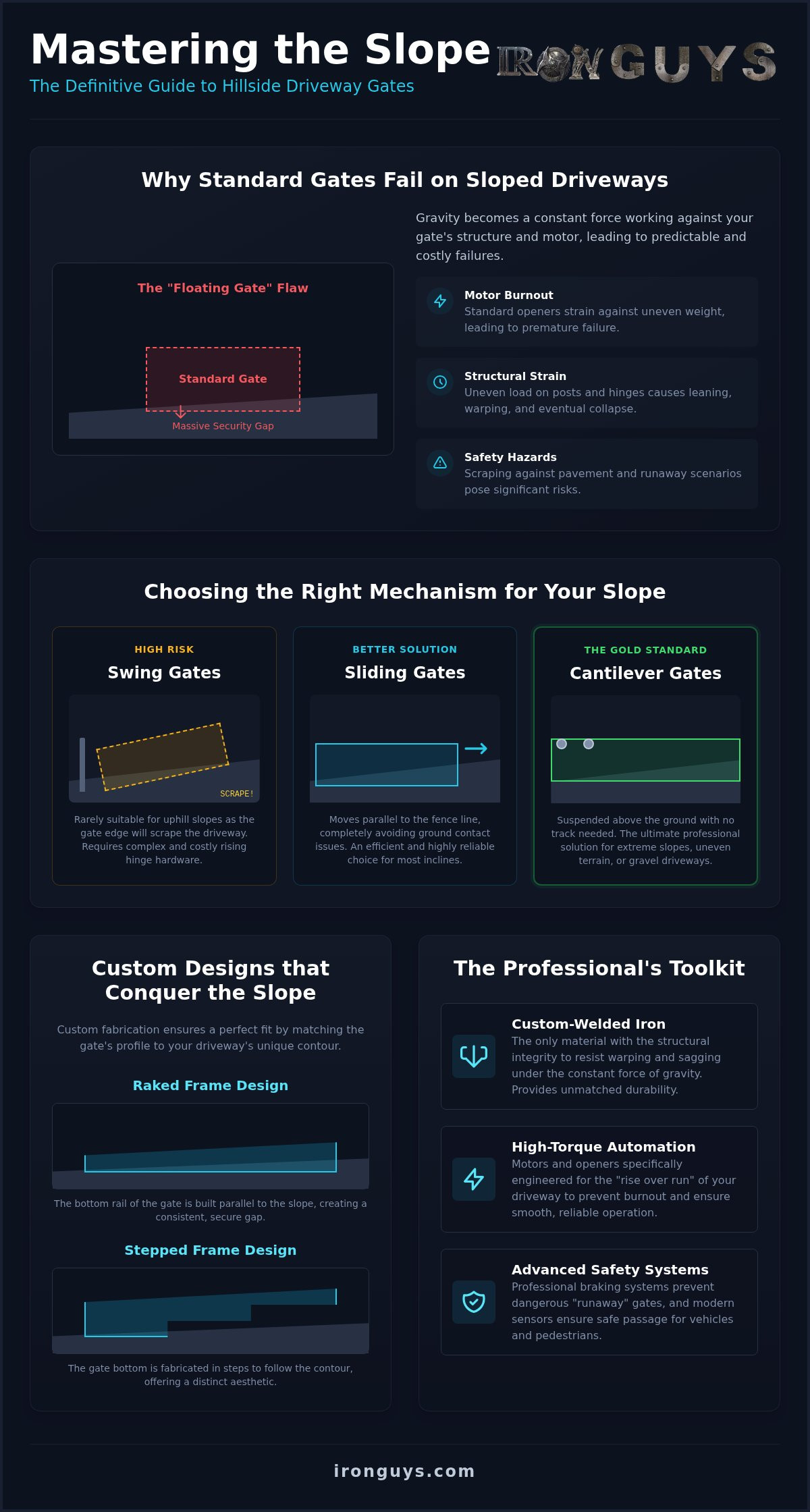
A primary issue in driveway gate design for sloped entrance is the “floating gate” syndrome. This occurs when a standard rectangular gate is installed over a sloping road, leaving a massive, wedge-shaped gap at the bottom. It isn’t just an aesthetic failure that ruins your curb appeal. It’s a security breach that allows animals or intruders to crawl underneath. Solving this requires more than just a standard installation. It requires custom fabrication that follows the specific contour of your land to maintain a tight, secure seal.
Ground clearance is another technical hurdle that many homeowners overlook. If you choose a swing gate that opens uphill, the bottom edge will scrape the pavement before it’s even halfway open. You have to calculate the exact arc of the swing to ensure the gate clears the rise of the driveway. Additionally, the structural load on your hinge posts is significantly higher on a slope. The downhill post carries a massive amount of lateral pressure. This can cause leaning or total structural failure if the footings aren’t deep enough or the metal isn’t heavy-duty iron.
Identifying Your Slope Type: Upward vs. Cross-Slope
Every hillside is unique. We categorize them into three main types to determine the best engineering approach:
- Upward Slopes: The ground rises toward the house. These often require specialized electric gate mechanisms like sliding or cantilever systems to avoid pavement contact.
- Cross-Slopes: The driveway tilts from left to right. These require “raked” designs where the gate frame is built as a parallelogram to match the ground’s angle.
- Compound Slopes: The most difficult scenario. The ground rises and tilts simultaneously. These require precise measurements to ensure the gate opens without hitting the ground or leaving huge gaps.
Why Material Choice Matters on a Hillside
Iron is the only material we trust for these complex builds. Wood and vinyl don’t have the structural rigidity to resist warping when gravity pulls on them unevenly. Custom-fabricated iron allows us to taper the bottom of the gate with precision, something mass-produced retail products can’t achieve. When your motor has to push a heavy gate uphill, you need the high-torque durability that only heavy-duty iron and professional-grade operators can provide. It’s about longevity and the security of a gate that actually works every time you press the remote.
Choosing the Right Gate Mechanism for Hillside Entrances
Selecting the right mechanical system is the difference between a gate that lasts decades and one that fails in six months. Standard swing gates are often the first choice for flat lots, but they rarely work on a hillside. For an uphill incline, a sliding gate is usually the superior option. It moves parallel to the fence line, requiring zero clearance in the direction of the slope. This eliminates the risk of the gate leaf striking the ground as it travels. It is the most efficient way to manage space when every inch of your driveway counts.
If your terrain is particularly uneven, a cantilever system is the professional choice. Unlike standard sliders that roll on a metal track, a cantilever gate is suspended above the ground. This setup bypasses the challenges of installing gates on sloping driveways where a ground track would be nearly impossible to level. For homeowners with extreme vertical constraints or very narrow entries, a vertical pivot gate offers a high-tech solution. These gates lift straight up, moving entirely out of the way without needing lateral or horizontal swing space. They are heavy-duty, reliable, and built to withstand the unique pressures of a hillside environment.
The Advantage of Cantilever Sliding Gates
A cantilever system uses a counterbalance and a series of rollers to support the weight of the gate. Because there is no track on the ground, you don’t have to worry about dirt, gravel, or drainage issues interfering with the operation. This is especially critical for Los Angeles properties where hillside runoff can frequently bury a standard track in silt. The gate essentially “floats” across the opening. It provides a clean, modern look while ensuring consistent performance on uneven pavement levels. If you’re looking for a heavy-duty solution, our team specializes in automatic gates designed specifically for these high-stress environments.
Rising Hinges and Hill-Drop Designs
Swing gates aren’t completely off the table for moderate slopes. Rising hinges are a mechanical marvel that actually lift the gate leaf as it swings inward. This creates the necessary clearance to pass over a rising driveway. This setup puts significant torque on the motor and hinges, so the fabrication must be precise. For cross-slopes, we often use hill-drop or raked designs. This involves tapering the bottom rail so it matches the grade of the road perfectly. In some cases, a bi-parting swing gate is the best move. By splitting the weight into two smaller leaves, you reduce the strain on the individual posts and the operator motor. This ensures your driveway gate design for sloped entrance remains functional and secure without constant maintenance visits.
Custom Metal Design Styles for Uneven Terrain
A driveway gate design for sloped entrance shouldn’t look like a compromise. It should look like a deliberate architectural choice. When dealing with uneven terrain, the primary goal is to reconcile the angled ground with the level lines of your home. We focus on two main fabrication techniques to achieve this: raking and stepping. Each method solves a specific terrain problem while ensuring the gate remains a heavy-duty security barrier. Precision is non-negotiable here. A fraction of a degree off in the shop means a gate that won’t align on the hillside.
The human eye prioritizes the top rail. If the top of your gate isn’t perfectly level with the horizon, the entire property looks tilted. We prioritize a level top-line even when the bottom of the gate has to follow a steep grade. This creates a balanced visual that anchors the entrance. For modern homes, horizontal iron presents a unique challenge. Aligning horizontal bars on a slope requires calculated spacing to prevent a “staircase” effect that clashes with the architecture. We use custom jigs to ensure every bar is perfectly parallel to the horizon or the grade, depending on the desired aesthetic.
The “Raked” Iron Technique
Raking is the gold standard for cross-slopes. In this process, we build the gate frame as a parallelogram rather than a rectangle. This allows the bottom rail to follow the exact angle of the driveway while the vertical pickets and top rail remain perfectly plumb and level. Custom fabrication is the only way to achieve this. It ensures a consistent 2-inch gap across the entire width of the entrance. This tight tolerance is vital for security. It prevents small animals or intruders from finding a weak point under the gate. Mass-produced retail products are square by default; they can’t be adjusted for a 10-degree hillside without leaving massive, ugly gaps.
Architectural Integration for LA Hillside Homes
Your gate is the first thing people see, so it needs to speak the same language as your house. We often design gates to match existing custom railings found on balconies or stairways. This creates a cohesive look from the street to the front door. For contemporary hillside builds, we frequently utilize horizontal iron works. These clean lines complement the tiered architecture common in Los Angeles. Integrating heavy-duty iron with stone pillars or concrete retaining walls adds a fortress-like feel. It provides the peace of mind that comes from high-quality craftsmanship and professional engineering. We don’t just build gates; we engineer hillside security solutions that last.
Stepped designs offer another alternative for extreme cross-slopes. Instead of a single angled bottom rail, the gate is built in sections that drop down like stairs. This creates a rhythmic, tiered look that works well with traditional or Mediterranean styles. It allows us to maintain the structural integrity of the iron while navigating a terrain that would make a standard gate impossible to install. Whatever the grade, we have the fabrication expertise to make it work.
Critical Measurements and Automation for Inclined Gates
Engineering is the backbone of a successful driveway gate design for sloped entrance. If you get the math wrong, even the most beautiful ironwork will eventually fail. You have to account for physics before you spark the welder. Gravity is a constant force that places immense strain on your equipment, and ignoring it is the fastest way to a broken motor.
Measuring the “Rise over Run” is the first critical step in a driveway gate design for sloped entrance. You must calculate the vertical change over the entire 90-degree arc of the gate’s travel. A simple straight-edge measurement at the hinge isn’t enough. You have to find the highest point of the pavement throughout the swing to avoid scraping. Once the rise is known, we calculate the additional torque needed for uphill motor operation. Moving a heavy iron gate against gravity requires significantly more force than a standard flat installation. We select heavy-duty actuators designed specifically for these high-stress environments. These units feature reinforced gearboxes and high-torque motors that won’t overheat under pressure.
Safety is equally important on a hillside. Positioning safety sensors (photo eyes) on uneven ground levels requires precision. We often fabricate custom mounting pedestals to ensure the infrared beams stay aligned despite the slope. This ensures your gate remains UL 325 compliant and safe for your family. Without this professional alignment, your safety system will trigger false stops or, worse, fail to detect an obstruction.
Powering the Hillside Gate
Standard residential openers often burn out on slopes within two years. They simply aren’t engineered for the constant strain of fighting gravity. We recommend hydraulic operators for steep grades. They offer superior heat dissipation and smoother movement under load compared to electromechanical versions. For remote hillside entries where running power is difficult, we integrate high-capacity solar kits and industrial-grade battery backups. This ensures your property stays secure even during a power outage.
Integrating Access Control
Modern security requires more than just a strong gate. We pair our hillside builds with phone entry systems for seamless guest management from your smartphone. For multi-family properties or hillside developments, we install apartment intercoms that provide reliable communication in deep canyon driveways. Ensuring a strong Wi-Fi or cellular signal at the property line is a core part of our installation process. We don’t just hang iron; we build fully integrated security solutions.
Don’t let gravity destroy your investment. Contact us today for a professional consultation on automatic gates engineered specifically for hillside performance.
Why Professional Iron Fabrication is Essential for Sloped Entries
Gravity doesn’t take days off. When you install a gate on a steep incline, every weld and hinge point is under constant lateral pressure that flat-lot installations never face. A driveway gate design for sloped entrance is a high-stakes engineering project where structural integrity is the only thing standing between a secure property and a mechanical catastrophe. Custom-welded iron is the only material with the tensile strength to resist the warping and sagging that gravity inflicts on hillside entries. Unlike mass-produced alternatives, our heavy-duty iron is fabricated to handle the specific torque requirements of your property’s unique grade.
Safety and liability are major concerns for hillside homeowners. We integrate professional braking systems and heavy-duty actuators to prevent “gate runaway.” This ensures that even if a motor fails, the gate won’t swing or slide uncontrollably down the hill. Navigating Los Angeles building codes is another hurdle. Current hillside ordinances for 2026 often require a 20 to 30-foot setback from the roadway. This allows vehicles to pull off the street completely before the gate operates. We handle the permit process, which typically takes 1 to 3 weeks for simple residential projects, ensuring your installation is fully compliant with local safety and zoning standards.
The Danger of DIY or Retail Gates on Hills
Off-the-shelf gates from big-box retailers are built for level ground. They use thin-gauge materials and standard hinges that aren’t designed for the uneven stress of a slope. These gates cannot be modified to fit a non-standard grade without compromising their structural integrity. Weak hinges on a slope are a significant safety hazard. They can snap under the weight of a heavy gate leaf. Additionally, hillside terrain often features shifting soil. We use deep, reinforced concrete footings to anchor your gate posts, providing a stable foundation that retail kits simply can’t offer.
Your Local Los Angeles Hillside Experts
We’ve been serving the community since 1998, providing the heavy-duty driveway gates los angeles residents trust for their hillside homes. Our team understands the specific soil conditions and stabilization requirements unique to LA’s canyons and hills. We don’t offer generic solutions. Our process begins with a comprehensive hillside survey to measure every degree of your slope. We then move to precision fabrication and a rigorous installation process. You get a direct, no-nonsense consultation and a security solution built to last for decades. Protecting your property requires the right expertise. Choose the team that has seen and solved every hillside challenge in the city.
Engineering Your Hillside Security Solution
Hillside properties demand an engineering approach that retail solutions can’t match. You now understand why custom fabrication is vital to eliminate the “floating gate” look and why heavy-duty motors are necessary to combat gravitational strain. A successful driveway gate design for sloped entrance requires a perfect alignment of math, metal, and mechanics. It turns difficult terrain into a secure, high-end architectural feature that enhances your home’s value and provides peace of mind.
We’ve served Los Angeles as a licensed contractor since 1998. Our team specializes in high-torque automatic systems and bespoke architectural iron work designed specifically for the city’s complex canyons. We take the burden of engineering and permits off your shoulders. Secure your hillside property with a custom Iron Guys gate. Get a professional quote today. Your property is an investment. Protect it with craftsmanship that won’t sag or fail under pressure. We’re ready to secure your hillside entry with the precision it deserves.
Frequently Asked Questions
Can I have an automatic gate if my driveway slopes upward?
Yes, you can install an automatic gate on an upward slope. You’ll need to choose a mechanism that avoids the rising ground, such as a sliding gate or a swing gate equipped with rising hinges. These specialized hinges lift the gate leaf as it opens. Professional driveway gate design for sloped entrance ensures the motor has enough torque to handle the extra weight of the incline without burning out.
What is the best type of gate for a steep hillside driveway?
Sliding and cantilever gates are the most effective options for steep hillsides. Because they move horizontally along the fence line, they don’t require the vertical clearance that swing gates do. Cantilever systems are particularly useful for uneven terrain because they don’t require a ground track. This prevents issues with debris and ensures smooth operation even on a 10% grade or higher.
How do you hide the gap under a gate on a sloped driveway?
We use custom raking and stepping techniques to eliminate the floating gate look. A raked gate is built as a parallelogram so the bottom rail follows the exact contour of the driveway while the top stays level. This approach is a core part of a driveway gate design for sloped entrance, ensuring a secure, consistent gap that keeps intruders and animals out.
Do sliding gates work better than swing gates on a hill?
Sliding gates are usually the superior choice for hillside properties. Swing gates require a clear arc to open, which is often blocked by an upward slope. A sliding gate moves parallel to your property line, making it much easier to manage in tight or steep spaces. It also places less strain on the hinges compared to a heavy swing gate fighting gravity on an incline.
Will a sloped driveway gate damage my automatic opener?
A sloped gate will damage a standard residential opener if it isn’t rated for high-torque applications. Gravity adds significant resistance when the gate moves uphill. To prevent motor failure, we use industrial-grade actuators or hydraulic operators. These systems are designed to dissipate heat and handle the constant physical strain of a hillside environment, ensuring your investment lasts for years.
Are there special hinges for gates on a slope?
Yes, rising hinges are specifically engineered for upward-sloping driveways. These hinges are set at an angle, causing the gate to lift as it swings inward. This creates the necessary clearance to pass over the rising pavement. While effective, these hinges require a high-torque operator to manage the weight shift as the gate moves through its opening arc.
Do I need a permit for a driveway gate in Los Angeles?
Yes, a permit is required for most automated gate installations in Los Angeles. The city regulates gate height, structural footings, and electrical wiring. You must also comply with specific setback requirements, which usually demand the gate be placed 20 to 30 feet back from the roadway. We handle the permit process to ensure your installation meets all local safety and zoning codes.
How much does a custom hillside driveway gate cost?
The total investment for a hillside gate depends on the slope’s severity, the material chosen, and the complexity of the automation system. Custom ironwork and high-torque motors are necessary for these terrains, which increases the engineering requirements. Many homeowners find that firms like Gate Tech Pros, which utilize Project-based fees for custom gate fabrication and installation, provide the most transparency when budgeting for these complex security upgrades. We provide detailed consultations to evaluate your specific property and provide a solution that balances heavy-duty security with architectural aesthetics.