
Your beachfront view shouldn’t come with the constant eyesore of orange rust streaks staining your expensive stone deck. In Los Angeles, the salt air is a relentless predator that eats through standard iron and cheap retail kits in just a few months. Finding the best material for coastal railings isn’t just about style; it’s about structural survival. If your metalwork isn’t specifically engineered for a high-salinity environment, it’s a liability waiting to happen.
We understand the frustration of rising maintenance costs and the worry that a corroded railing might fail when a guest leans on it. You deserve a “set and forget” system that increases your property value while keeping your ocean views completely unobstructed. This 2026 guide shows you exactly which materials survive the brutal salt air of Southern California and which will fail within a single season. We’ll cover everything from marine-grade 316 stainless steel cable railings to the current 42-inch height requirements mandated by the California Building Code. It’s time to build something that lasts.
Key Takeaways
- Learn how salt crystals attack metal oxide layers and why the “Splash Zone” requires specialized heavy-duty protection.
- Discover why marine-grade 316 stainless steel is the best material for coastal railings to ensure your balcony survives the relentless LA salt spray.
- Understand how stainless steel cable railings provide the perfect balance of modern aesthetics, unobstructed ocean views, and reduced wind load.
- Prevent structural failure by identifying the “weakest link” in your railing system; matching your fasteners to your railing grade is critical for longevity.
- Stay compliant with the 2022 California Building Code requirements for residential guardrail heights and load-bearing standards.
The Coastal Corrosion Challenge: Why Salt Air Destroys Standard Railings
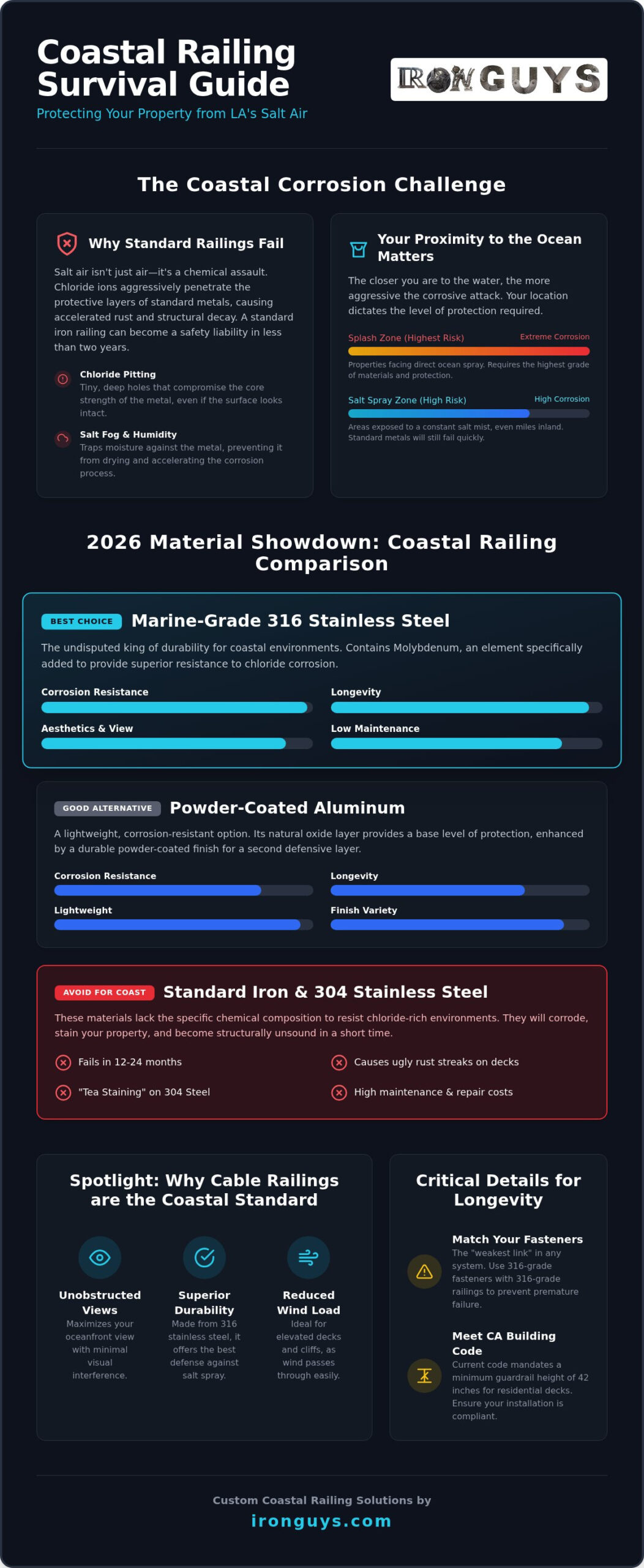
Living on the Los Angeles coast means your property is under constant chemical attack. Salt air isn’t just a smell; it’s a delivery system for chloride ions that aggressively seek out metal surfaces. These ions penetrate the protective oxide layers that usually shield steel. Once that barrier breaks, the underlying metal begins to oxidize at an accelerated rate. This electrochemical process, known as The Coastal Corrosion Challenge, can turn a standard iron railing into a rusted liability in less than two seasons.
The severity of this attack depends on your proximity to the water. Properties in the “Splash Zone” deal with direct ocean spray, while those in the “Salt Spray Zone” face a constant mist that carries miles inland. Finding the best material for coastal railings requires understanding these zones. In areas like Malibu and Santa Monica, the high morning humidity traps salt against the metal, keeping it wet and active for hours. This accelerates rust far faster than it would in drier, inland neighborhoods. The hidden danger is crevice corrosion, which occurs in the tight spaces of joints and welded sections where salt accumulates and never washes away.
Chloride Pitting: The Silent Railing Killer
Pitting is a specific, dangerous form of corrosion that creates tiny, localized holes in the metal surface. While the railing might look mostly intact from a distance, these pits tunnel deep into the structural core. Standard carbon steel often fails within 12 to 24 months when installed near the surf. Salt-laden fog acts like a sponge, holding moisture against the metal surface and preventing evaporation. This constant wet-dry cycle deepens the pits until the structural integrity of the guardrail is compromised, creating a serious safety hazard for your family and guests.
Los Angeles Coastal Micro-Climates
Not all coastal properties face the same risks. Malibu’s unique geography creates a humid trap for salt air, while the elevated cliffs of Palos Verdes experience higher wind loads but slightly less direct moisture. In the South Bay, prevailing winds push salt deeper into residential blocks, affecting homes several streets back from the sand. Regardless of the specific micro-climate, all new installations must meet the 2022 California Building Code. This mandates a minimum guardrail height of 42 inches for residential decks. Choosing the best material for coastal railings is the only way to ensure your custom metalwork remains compliant and secure for decades instead of months.
Top 3 Materials for Beachfront Railings: A 2026 Comparison
Selecting the best material for coastal railings isn’t about finding something that looks good for a weekend. It’s about chemical resistance. In the aggressive Los Angeles salt environment, only a few materials actually survive. Most homeowners make the mistake of using standard wrought iron or retail-grade steel. These materials lack the internal chemistry to fight off oxidation. Within a year, you’ll see bubbling paint and structural decay. To avoid this, you must choose materials specifically engineered for marine exposure.
316 Stainless Steel vs. 304 Stainless Steel
The primary difference between these two grades is Molybdenum. This element is added to 316 stainless steel to provide superior resistance to chlorides. If you use 304 stainless steel, you’ll likely see “tea staining” within months. This is a brownish surface discoloration that looks like rust but is actually localized pitting. It’s a visual sign of failure. For beachfront properties, the rule is simple: If you can smell the ocean, you need 316. This material is the undisputed king of durability for custom balcony railings.
Marine-Grade Aluminum and High-End Finishes
Powder-coated aluminum is a lightweight, corrosion-resistant alternative. It’s particularly useful for hillside properties in areas like Pacific Palisades where weight restrictions are a factor. Aluminum naturally forms an oxide layer that prevents deep corrosion. Modern architectural-grade powder coating adds a second layer of protection. These finishes come in matte blacks and bronzes that match current LA architectural trends. Effective Corrosion prevention and control strategies often involve this combination of resilient base metal and high-performance coatings.
Laminated Glass and Wrought Iron Warnings
Laminated glass systems are excellent for maximizing views, but they require high-quality metal hardware to stay safe. Using standard wrought iron without specialized hot-dip galvanizing or marine-grade primers is a mistake. The salt air finds every microscopic pore in the paint. Once the iron begins to expand from rust, it can actually crack the glass panels or pull anchors out of your deck. To get the best material for coastal railings, you must prioritize chemical composition over initial cost. Investing in marine-grade materials now prevents a total replacement in three years. It’s the only way to ensure your investment survives the brutal California coast.
Why Stainless Steel Cable Railings are the LA Coastal Standard
In the high-stakes world of Los Angeles real estate, the ocean view is your most valuable asset. Any barrier that slices through the horizon reduces the market value of your property. This is why stainless steel cable railings los angeles have become the architectural standard from Malibu to Manhattan Beach. They provide the security of a heavy-duty guardrail while remaining virtually invisible. When you’re looking for the best material for coastal railings, cable systems offer a modern aesthetic that traditional pickets can’t match.
Beyond the visual appeal, these systems solve a major engineering hurdle: wind load. Solid glass panels or traditional wide-picket railings act like sails during Santa Ana wind events. This constant pressure puts immense mechanical strain on your deck’s structural mounts. Cable systems allow air to flow freely through the railing. This reduces the force applied to your balcony and prevents the vibration that can loosen fasteners over time. Because cables have minimal surface area, there’s also less metal for salt crystals to settle on, which means less cleaning for you.
Anatomy of a Marine-Grade Cable System
A professional cable system is only as good as its tensioning hardware. In the fluctuating temperatures of the California coast, metal expands and contracts. We use high-quality turnbuckles and swage fittings that allow for precise adjustments, ensuring your cables stay taut and don’t sag. Safety is the priority. To meet the Los Angeles Department of Building and Safety (LADBS) requirements, we space our cables so that a 4-inch sphere cannot pass through at any point. This “sphere test” is a critical safety standard for protecting children and pets on elevated decks.
Maintenance Realities for Cable Railings
While cable systems are low-maintenance, they aren’t “no-maintenance.” To keep them bright and clear, you should rinse the salt buildup off the cables with fresh water at least once a month. This simple step prevents the chloride ions from sitting on the metal. After we weld our custom posts, we perform a “passivation” process. This is a chemical treatment that removes free iron from the surface and restores the protective chromium oxide layer. This ensures your best material for coastal railings is chemically sealed against the salt air from day one. Using a simple microfiber cloth and a marine-grade stainless steel cleaner once a season will keep your system looking brand new for decades.
The Secret to Longevity: Fasteners, Hardware, and Maintenance
Even the best material for coastal railings will fail if you ignore the hardware. We call this the “Weakest Link” theory. Many contractors save money by using 316 stainless steel for the railing but 304 stainless steel for the anchor bolts. This is a fatal mistake. In the salt air of Santa Monica, those 304 bolts will bleed rust onto your expensive deck. They will eventually seize or snap. Every single component, down to the smallest washer, must match the marine-grade specification of the railing itself.
Galvanic corrosion is another silent killer. This happens when you mix dissimilar metals, like aluminum and stainless steel, in the presence of salt water. The salt acts as an electrolyte, creating a tiny electrical current that eats away the weaker metal. To prevent this, we use non-conductive gaskets and nylon washers to isolate different metals. This barrier stops the electrochemical reaction before it starts. Professional isolation is what separates a custom installation from a DIY kit that fails in two seasons.
The Fastener Specification That Matters
Your railing is only as secure as the bolts holding it to the structure. Every anchor bolt must be marine-grade 316 stainless steel. We also apply anti-seize lubricants to all threaded hardware. This prevents “galling,” where stainless steel threads lock together permanently due to friction and salt exposure. Don’t settle for retail-grade hardware from a big-box store. Industrial-grade fasteners are the only way to ensure your balcony remains a safe environment for twenty years or more. If you want a system built to survive the coast, consult Iron Guys for a custom railing solution.
Cleaning and Care for Oceanfront Metalwork
Maintenance doesn’t have to be a chore. A simple freshwater rinse once a month is the easiest way to double the life of your metalwork. This removes the salt crystals before they can penetrate the protective oxide layer. Avoid using abrasive chemicals or steel wool, as these can strip the protection and leave tiny iron particles that will rust. If you start to see surface tea staining, it’s time to call a professional for re-passivation. This chemical process restores the chromium-rich surface that makes stainless steel “stainless.” Use this 2026 maintenance checklist to stay ahead of the salt:
- Monthly: Rinse all surfaces with fresh water to remove salt crystals.
- Quarterly: Inspect cable tensioners and swage fittings for any signs of movement.
- Bi-Annually: Wipe down cables with a marine-grade stainless steel cleaner.
- Annually: Check all mounting points and anchor bolts for discoloration or pitting.
By following these steps, you ensure that the best material for coastal railings actually delivers on its promise of longevity. Protecting your investment takes only five minutes a month, but it can save you tens of thousands in replacement costs over the next twenty years.
Custom Coastal Railing Solutions in LA: The Iron Guys Advantage
Choosing the best material for coastal railings is only half the battle. The other half is the quality of the fabrication. Since 1998, Iron Guys has provided custom metalwork designed specifically for the unique micro-climates of the Los Angeles coast. We understand that a railing in Malibu faces different humidity levels and salt concentrations than one in Manhattan Beach. Our team doesn’t rely on mass-produced solutions. We build heavy-duty systems that provide both high-end aesthetics and long-term security. This local expertise ensures your property is protected by a system that actually lasts.
A major advantage of our custom approach is the ability to integrate your entire security perimeter. Many beachfront homeowners want a cohesive look that extends from their balcony to their driveway. We can match your 316 stainless steel cable railings with high-performance automatic gates los angeles. This creates a unified defensive line for your home. By handling both the architectural iron works and the technical entry systems, we remove the burden of coordinating multiple contractors. You get a professional, licensed service that prioritizes durability above all else.
From Malibu to Manhattan Beach: Our Process
Our workflow is methodical and efficient. We start with precise on-site measurements to account for the specific pitch and layout of your deck. Our experts use CAD design to ensure every post and cable run meets current safety standards and the 2022 California Building Code. Once the design is finalized, we move to in-house fabrication. We use specialized marine-grade coating processes that retail kits simply cannot offer. Our licensed Los Angeles contractors then handle the installation, ensuring every anchor bolt is perfectly seated and isolated to prevent corrosion.
Why ‘Custom’ Beats ‘Retail’ Every Time
The difference between custom work and retail kits is structural. Most “snap-together” systems use thin-walled tubing and plastic components that degrade quickly in salt air. We use heavy-gauge metal that provides superior strength and a more substantial feel. This is critical for meeting the 200-pound concentrated load requirement for guardrails. Custom fabrication also allows for the “LA Modern” look, using horizontal iron or stainless steel profiles that perfectly complement contemporary beachfront architecture. Don’t settle for a temporary fix when you can have a permanent solution. Consult with an Iron Guys expert today to secure your view with the best material for coastal railings available in Southern California.
Secure Your View with Professional Marine-Grade Metalwork
Your beachfront balcony is more than just a deck; it’s an investment in the Los Angeles lifestyle. Protecting that investment requires moving beyond cheap retail solutions that rust within a season. You now know that 316 marine-grade stainless steel is the best material for coastal railings because of its unique chemical resistance to chloride pitting. We’ve also seen how custom-welded systems provide the structural integrity needed to meet the 42-inch height requirements of the 2022 California Building Code.
Iron Guys has been the trusted local authority for custom architectural fabrication since 1998. We don’t deal in mass-produced kits. We specialize in heavy-duty, marine-grade 316 stainless steel systems built to handle the relentless salt spray of the Pacific. Our team handles everything from CAD design to professional installation. Stop worrying about rust staining and structural failure. Get a No-Nonsense Quote for Your Coastal Railing Project and enjoy your ocean view with total peace of mind. Your property deserves the security of high-quality craftsmanship.
Frequently Asked Questions
Is 304 stainless steel okay for coastal railings in Malibu?
No, 304 stainless steel is not suitable for beachfront properties in Malibu. It lacks molybdenum, an essential element found in 316 grade that resists chloride pitting. In a high-salinity environment like the Malibu coast, 304 will develop brown surface discoloration, known as tea staining, within just a few months of installation.
How often do I need to clean my coastal railings to prevent rust?
You should rinse your railings with fresh water at least once a month. This simple step removes salt crystals before they can penetrate the metal’s protective oxide layer. For homes directly on the sand in areas like Santa Monica, a bi-weekly rinse is even better to maintain the finish and prevent long-term pitting.
What is the difference between 316 and 316L stainless steel for railings?
316L is a low-carbon version of 316 stainless steel. It’s the superior choice for custom fabrication because it prevents carbide precipitation during the welding process. This ensures that the welded joints remain as corrosion-resistant as the rest of the railing, preventing the common weak points where rust usually begins to form.
Can I use aluminum railings if I live directly on the beach?
Yes, you can use aluminum if it’s architectural-grade and protected by a high-quality powder coating. Aluminum naturally resists rust, though it can still suffer from surface oxidation if not properly finished. It’s a great choice for Los Angeles properties with weight restrictions or those requiring specific architectural colors to match a modern aesthetic.
Do glass railings require more maintenance than metal in a salt environment?
Glass railings generally require more frequent cleaning than metal cable systems. Salt spray dries on the glass, creating a cloudy film that obscures your ocean view and can eventually etch the surface. While metal only needs a quick rinse, glass often requires squeegeeing and specialized cleaners to maintain the unobstructed view you paid for.
What is the best coating for metal railings near the ocean?
A high-performance, architectural-grade powder coating is the best material for coastal railings when working with aluminum. For custom iron works, we use specialized marine-grade primers and thick topcoats. These coatings provide a critical physical barrier that prevents salt and moisture from ever reaching the base metal, significantly extending the system’s lifespan.
How much more expensive is marine-grade 316 stainless steel?
Marine-grade 316 stainless steel requires a higher initial investment than standard 304 or carbon steel. However, it’s the most cost-effective choice over the life of your property. You avoid the recurring costs of repainting and the eventual total replacement that comes with using inferior materials that can’t survive the brutal California salt air.
Will my coastal railing stay clear or will it eventually turn white/cloudy?
Your railing will stay clear if it’s properly passivated during fabrication and rinsed regularly. A white, cloudy appearance is usually just salt buildup that can be washed away with fresh water. If the metal itself becomes cloudy, it’s a sign of surface oxidation, which is why we prioritize 316 stainless steel to maintain a bright finish.