
Your gate scraping against the concrete isn’t just an annoyance; it’s a visible failure of discipline and engineering. You’re sick of fighting a misaligned latch every time you pull into the driveway. Perhaps you’ve already wasted $11.94 on a flimsy retail anti-sag kit that promised a fix but only delivered more weakness. We know the frustration of watching heavy iron pull on your house or post until the structure screams. It’s time to stop the bleeding and master how to prevent gate from sagging using the same raw grit we use to forge a legacy in the iron game.
You want a gate that swings with the effortless grace of a single finger while maintaining the structural peace of mind of a fortress. We’ll give you the no-nonsense engineering principles to stop the drag and ensure your entrance stays perfectly aligned forever. This guide breaks down the structural foundation, hinge physics, and the heavy-duty reinforcements needed to avoid a $1,200 professional repair bill. No fluff. No excuses. Just unyielding results.
Key Takeaways
- Master the physics of leverage and over-engineer your posts to create an unbreakable foundation that refuses to lean.
- Eliminate frame racking by using strategic diagonal bracing to forge a rigid structure that resists gravity’s constant pull.
- Discover the professional secrets for how to prevent gate from sagging by prioritizing high-grade adjustable hinges over cheap retail junk.
- Secure your legacy with custom-fabricated ironwork designed to handle extreme wind loads and the unique slopes of your terrain.
- Stop settling for mediocrity and demand a gate that operates with one-finger precision through uncompromising engineering standards.
Stop the Drag: The Brutal Reality of Gate Sag
A sagging gate isn’t a minor glitch; it’s a structural surrender. It’s the moment your perimeter stops providing security and starts broadcasting weakness. You see it every day. The latch side dips. The metal scrapes. The frame groans. This is gate sag. It’s a failure of geometry where the latch side drops below the hinge side, turning your entrance into a dragging liability. If you want to know how to prevent gate from sagging, you have to respect the physics of leverage. Every inch of width on that gate multiplies the stress on your hinge post. A standard driveway gate acts as a massive lever, constantly trying to rip its anchor out of the earth. You can’t out-muscle gravity with a cheap fix. You have to out-engineer it.
The Anatomy of a Failing Gate
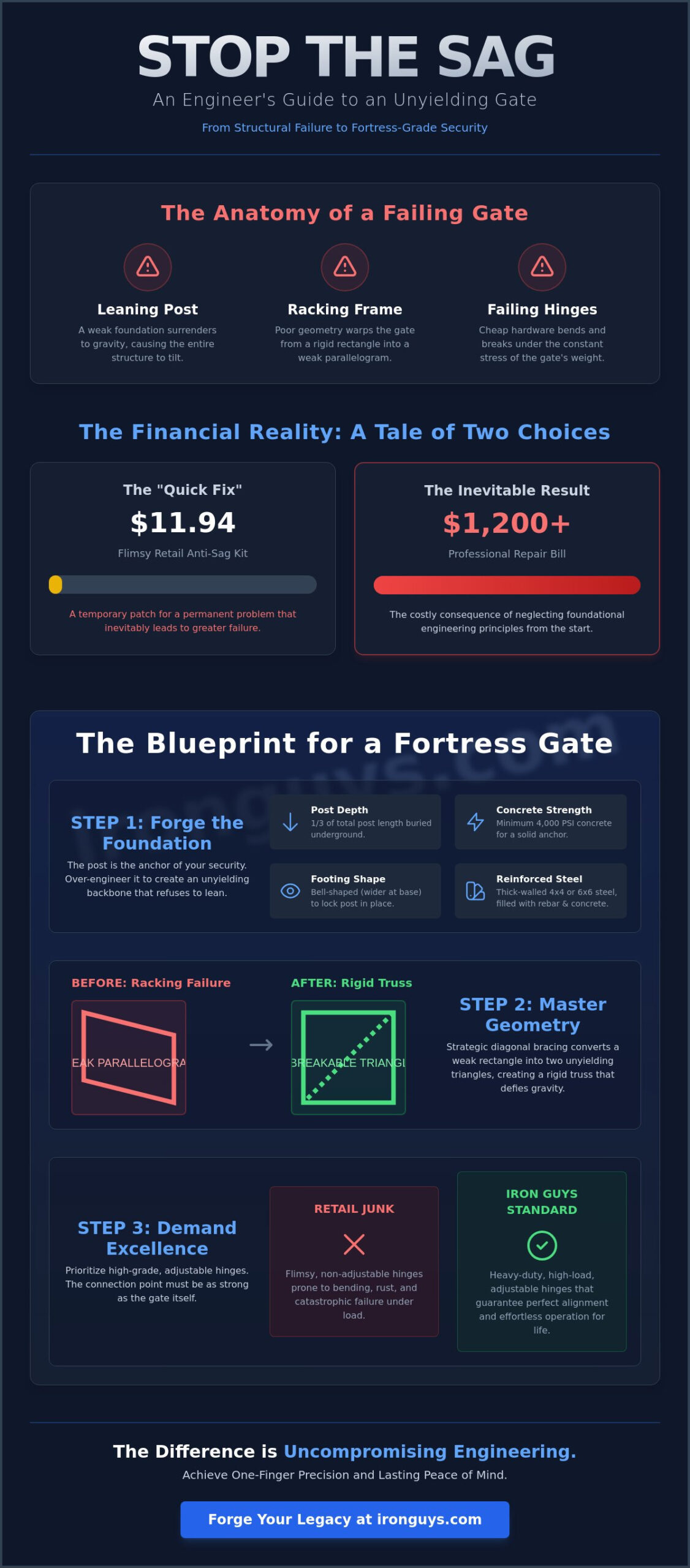
Failure happens in three specific places: the post, the hinges, and the frame. The “grind” of daily operation reveals the truth about your equipment. Weak welds and thin, hollow metal might look fine on the showroom floor, but the iron doesn’t lie. While wood expands and contracts with the seasons, metal structural failure is permanent. It’s a slow-motion collapse. If your frame lacks proper Structural Geometry, it will eventually rack. Racking is the process of a rectangle warping into a parallelogram. Once that happens, your security is compromised. We’ve seen $1,200 repair bills caused by nothing more than thin-walled tubing that couldn’t handle the pressure. Don’t let your gate become a statistic.
Why Gravity Never Sleeps
Gravity is the ultimate opponent. It never takes a rest day. Even when your gate is closed and locked, it applies constant torque to the hinge post. This rotational force is why a gate that “used to be fine” suddenly becomes a liability. Torque is the rotational force applied to your hinge post by the massive weight of a 10-foot driveway gate. Without uncompromising engineering, that force will win every single time. Stop looking for a $12 quick fix from a big-box store. Those flimsy kits are built for mediocrity. You need to understand how to prevent gate from sagging by out-working gravity with superior materials and better math. A sagging gate is a sign of a compromised perimeter; it’s time to build an entrance that stands its ground.
The difference between a “retail” gate and a custom iron masterpiece is the weight of the legacy. Professional gate repairs can scale up to $1,500 for complex automatic systems. You avoid that cost by doing it right the first time. We don’t build for “good enough.” We build for absolute rigidity. We build for the long haul. If your gate isn’t swinging with one-finger precision, you haven’t finished the job. It’s time to stop the drag and start forging a solution that lasts.
The Foundation is the Backbone: Forging an Unyielding Post
The post is the anchor of your security. If it leans even a fraction of an inch, your gate will sag. There is no middle ground here. We operate on an over-engineer philosophy: bigger, deeper, and stronger than the “minimum code” requires. In Los Angeles, your soil is your enemy. From the loose coastal sand of Malibu to the shifting hillside clay of the canyons, the earth is constantly trying to move your iron. You need a foundation that refuses to budge. While some homeowners search for how to build a wood fence gate that won’t sag, they are playing a short-term game. Wood rots. Wood warps. Metal is the only legacy choice for a warrior’s entrance. If you want to master how to prevent gate from sagging, start by burying the weakness.
Deep-Set Success: Depth and Concrete
Depth is non-negotiable. Follow the Iron Guys’ rule of thumb: at least 1/3 of the total post length must be underground. If your gate stands 6 feet high, you need 3 feet of steel and concrete anchoring it to the earth. Don’t just dig a straight hole. Forge a bell-shaped footing that is wider at the base than at the top. This geometry locks the post into the soil, preventing the frost heave or ground shifting that plagues amateur installs. For heavy iron gate foundations, demand a minimum of 4,000 PSI concrete. This isn’t just mud; it’s the bedrock of your security.
Post Wall Thickness and Material
Stop settling for the thin-wall tubing found at big-box retailers. That flimsy metal will fold under the torque of a real gate. We use 4×4 or 6×6 square steel tubing with a wall thickness that commands respect. This is structural steel, not a toy. For maximum grit, we place internal rebar into the post before filling the entire cavity with concrete. This creates a solid, reinforced pillar that resists bending and vibration. When we engineer driveway gates, we build them to outlast the house they protect. This is the level of discipline required to know how to prevent gate from sagging for the long haul. Build it once. Build it right. Build it with iron.
A weak post is an insult to your property. It’s a white flag of surrender to gravity. You wouldn’t skip leg day and expect a massive squat; don’t skip the foundation and expect a perfect gate. Every ounce of effort you put into the ground pays dividends in a gate that swings true for decades. Get the foundation right, or don’t bother starting the project.
Structural Geometry: Bracing for Absolute Rigidity
A rectangle is a shape in crisis. Without internal support, every rectangular gate frame is just a parallelogram waiting to happen. Gravity pulls on the latch side with relentless force, trying to fold the structure at its joints. If you want to master how to prevent gate from sagging, you must embrace the geometry of the triangle. A triangle is the only geometric shape that refuses to deform under pressure. For extra-wide driveway gates, we don’t just build a simple frame; we engineer a truss. This is the same principle used in massive bridges to span voids without bowing. It’s about creating a rigid skeleton that laughs at the weight of the iron.
The “Compression vs. Tension” debate is where many amateurs lose the war. While some rely on thin cables to pull the gate up, we prioritize solid iron braces that push back. A diagonal brace in compression is the ultimate defense against racking. Bolted or screwed frames from big-box retailers are destined for the scrap heap because they rely on the friction of a fastener. We rely on the fusion of a deep-penetration weld. This is the level of commitment required to understand how to prevent gate from sagging for a lifetime. You don’t want a gate that “holds on;” you want a gate that stands defiant.
The Diagonal Brace: The Warrior of Geometry
To win the fight against gravity, the brace must run from the bottom hinge side to the top latch side. This positioning allows the solid iron to act as a pillar within the frame, absorbing the downward load and transferring it back to the post. For modern, minimalist designs, we sometimes utilize stainless steel cable tensioners, but these require constant maintenance to keep the tension high. A 45-degree angle is the structural sweet spot for support. This angle distributes the load evenly between the vertical and horizontal members, ensuring the frame stays square under the most savage conditions. If your angle is too shallow or too steep, you’re wasting metal.
Welded Gussets and Corner Strength
The “elbow” of the gate is where the most torque accumulates. Corner gussets, which are triangular plates welded into the corners, prevent these joints from bending under the weight. We always favor mitered welds over butt welds because they provide a larger surface area for the metal to fuse. A mitered joint creates a continuous loop of strength around the perimeter. Horizontal iron work also provides natural structural rigidity, acting as internal bracing that reinforces the entire system against wind load and vibration. When you combine gussets with a mitered, fully welded frame, you create a structure that is fundamentally unyielding. This is the Iron Guys standard. We don’t build gates that eventually fail; we forge legacies that stay level.
Hardware Excellence: Hinges That Refuse to Quit
Hardware is the connective tissue of your entrance. You don’t put budget tires on a supercar; don’t put a $10 retail hinge on a $5,000 custom gate. The hinges are the joints where every pound of pressure is concentrated. If you’re searching for how to prevent gate from sagging, the answer starts with hardware that refuses to quit. We utilize heavy-duty J-bolt hinges or industrial barrel hinges because they possess the load-bearing capacity to handle hundreds of pounds of solid iron without flinching. Cheap hinges are a white flag of surrender to gravity. They will bend, bind, and eventually snap under the pressure of a real iron frame.
Maintenance is a discipline, not a suggestion. Metal-on-metal fatigue is a silent killer of structural integrity. You must grease your hinges every six months to ensure smooth operation and prevent the friction that leads to premature wear. A well-maintained hinge ensures that the torque doesn’t turn into a destructive force. If you hear a squeak, you’re already failing the maintenance test. Consistency in care is what separates an Iron Guy from an amateur. Treat your hardware with the same respect you give your training equipment, and it will never let you down.
Ball-Bearing Hinges for Heavy Loads
In the steep terrain of the LA hills, automatic gates are the standard for high-end security. These systems require ball-bearing hinges to survive the daily grind. These hinges use internal bearings to distribute weight with surgical precision, allowing the gate to swing with zero resistance. This isn’t just about luxury; it’s about protecting your equipment. A smooth-swinging gate reduces the strain on your automatic gates operator motor, extending the life of the system by years. Silent operation is the ultimate sign of professional engineering. If your gate sounds like a rusted wreck, your hardware is failing the mission.
Adjustability: Preparing for the Long Game
The earth moves. Concrete settles. Your gate needs to be ready for the long game. This is why we demand adjustable J-bolts for our installations. These bolts allow for micro-adjustments to the gate’s level even years after the initial installation. If the ground shifts or the post settles, you simply turn a nut to bring the latch back into perfect alignment. This is a critical component of how to prevent gate from sagging over decades of use. Pro tip: use a string line and a level to check your alignment every season. If you aren’t perfectly plumb, you’re putting unnecessary stress on the entire structure. Proper hinge offset prevents the frame from binding against the post, ensuring a clean, savage swing every single time.
The Iron Guys Standard: Custom Engineering for LA Homes
Off-the-shelf solutions from big-box retailers are destined for the scrap heap. They are built for a flat, generic world that doesn’t exist in the rugged terrain of Southern California. If you want to know how to prevent gate from sagging in the real world, you have to account for wind load, seismic shifts, and the relentless pull of a 15 percent grade driveway. At Iron Guys, we don’t sell mass-produced trash. We forge bespoke solutions. Every piece of iron we weld is a calculated strike against mediocrity. We engineer for the specific physics of your property because anything less is a liability. Your entrance is the first line of defense; don’t let it be the weakest link.
Mediocrity is a choice, and it’s one that costs you money every single year. You can keep paying for $500 repairs every time the ground shifts, or you can build a legacy. We take the engineering principles of the gym floor and apply them to the forge. We don’t just build gates; we build unyielding barriers that command respect. If you are tired of the drag and the constant misalignment, it is time to upgrade to a standard that matches your ambition. We provide the grit and the steel; you provide the property worth protecting.
Hillside and Slope Challenges in Los Angeles
The Hollywood Hills and Bel Air aren’t just zip codes; they are engineering battlegrounds. You can’t hang a standard gate on a 10-degree slope and expect it to swing true for more than a month. We deploy specialized rising hinges that lift the gate as it opens, clearing the rising grade without sacrificing structural integrity. For properties where a swing gate is impossible, we install heavy-duty sliding gate tracks anchored into reinforced concrete. We understand the soil stability issues in the canyons. We build for the 2025 California Wildland-Urban Interface (WUI) Code, ensuring your non-combustible iron entrance meets the strict safety standards effective January 1, 2026. This local expertise is the difference between a gate that lasts five years and one that outlives the mortgage.
Automatic Gate Integration
A sagging gate is a motor killer. When your gate drags, your automatic operator has to work twice as hard to overcome the friction. You’ll burn out a high-end motor in months, turning a minor alignment issue into a $1,500 catastrophe. We sync our perfectly balanced ironwork with advanced phone entry systems and apartment intercoms to create a seamless, high-security perimeter. Don’t waste money on a premium entry system only to choke it with a failing frame. Master how to prevent gate from sagging today by investing in a system that is balanced to the millimeter. Stop fighting the iron and start winning the war against gravity.
Get an unyielding custom gate quote from the Iron Guys and secure your perimeter once and for all.
Forge Your Legacy: The End of the Sagging Entrance
You now possess the blueprints for a gate that refuses to buckle under pressure. We’ve defined the bedrock foundation required for a 6-foot post and the triangular geometry that prevents frame racking. You understand that ball-bearing hinges aren’t a luxury; they’re the industrial joints of a system built to survive the daily grind. This isn’t just about a driveway. It’s about maintaining the structural integrity of your perimeter with uncompromising discipline. Since 1998, we’ve served as local Los Angeles artisans who master the shifting clay of the canyons and the coastal salt of Malibu. We are specialists in heavy-duty structural ironwork who don’t tolerate mediocrity.
Stop searching for how to prevent gate from sagging and start building for the long haul. The Iron is a silent teacher; let it reveal your commitment to excellence. Your entrance should be as unyielding as your work ethic. Take action now and demand a standard that commands respect. Stop the sag and secure your legacy with Iron Guys custom gates. Stand tall. Keep your entrance square. Your legacy begins at the curb.
Frequently Asked Questions
Why does my gate sag even though the post feels solid?
Your frame is likely racking because it lacks internal structural integrity. Even if your post is a rock-solid anchor, a rectangular frame will warp into a parallelogram if the joints aren’t reinforced. This is a failure of geometry, not the foundation. You need diagonal bracing or welded gussets to force the frame to maintain its shape against the relentless pull of gravity.
Can I use a wheel to stop my gate from sagging?
No, a wheel is a desperate hack that belongs in the scrap heap. Wheels fail the moment they hit a pebble or the ground settles. They mask the underlying structural failure and put erratic stress on your hinges. Real engineering solves the problem at the source. If you want to know how to prevent gate from sagging, you fix the frame and the post; you don’t add a training wheel to a failing system.
What is the best material for a gate that will never sag?
Heavy-duty structural steel is the only material for a warrior’s entrance. Avoid the hollow, thin-walled aluminum found in retail aisles. You need the density and strength of iron with deep-penetration welds to ensure the structure remains unyielding. Steel provides the rigidity required to span wide driveways without bowing or losing its alignment over decades of savage use.
How deep should I dig the hole for a heavy iron gate post in Los Angeles?
Dig your hole at least 36 inches deep or one-third of the total post height. In the shifting hillside clay of the Hollywood Hills, a shallow 24-inch hole is a recipe for disaster. Forge a bell-shaped footing that is wider at the base to lock the post into the earth. This over-engineered foundation ensures your post stays plumb when the soil gets saturated during heavy rains.
Is it better to have a brace in tension or compression?
Compression is the superior choice for heavy iron work. A solid diagonal brace running from the bottom hinge side to the top latch side pushes back against the weight of the gate. While stainless steel cables use tension to pull the gate up, they can stretch over time. A solid iron brace provides absolute rigidity that refuses to budge, ensuring your latch stays perfectly aligned forever.
What happens if I ignore my sagging gate?
Ignoring the sag will destroy your latch and burn out your automatic gate motor. A dragging gate creates massive friction that forces your operator to work beyond its rated capacity. You’ll eventually face a $1,500 repair bill for a fried motor and a ruined frame. Stop the damage now before a minor alignment issue turns into a total structural collapse of your perimeter security.
Can a sagging gate be repaired, or do I need a total replacement?
Repairs are possible if the failure is limited to the hinges or a leaning post. We can often reinforce a post with new 4,000 PSI concrete footings or swap out weak hardware for adjustable J-bolts. However, if the frame itself has racked due to thin metal or weak welds, a total replacement is the only way to ensure a legacy of security. Don’t waste money patching a fundamentally broken design.
How often should I grease my gate hinges to prevent wear?
Grease your hinges every 180 days to maintain peak performance. This consistency prevents metal-on-metal fatigue and ensures your gate swings with the precision of a single finger. Use a high-quality lithium grease to protect the ball bearings from the Los Angeles grit and salt air. Regular maintenance is the discipline required for how to prevent gate from sagging and keep your hardware from seizing up.