
Average is the enemy of excellence. Most homeowners treat their perimeter like an afterthought until the rust sets in and the cables sag under the weight of poor choices. You’re here because you refuse to settle for mediocre off-the-shelf kits or unpredictable contractor quotes that change with the wind. Understanding the stainless steel cable railing cost per foot isn’t just about a line item on a spreadsheet; it’s about investing in a structural crucible that withstands the elements and enhances your property value. We know the frustration of staring at a “budget” 304 stainless steel system that’s already pitting while you demand a solution that actually lasts.
Stop guessing and start building with this definitive breakdown of cable railing investment factors and high-performance materials. You’ll gain a clear understanding of what actually drives the bottom line, from the superior corrosion resistance of 316 marine-grade steel to the uncompromising 42-inch height requirements of California code. We’ll strip away the confusion and provide the intelligence you need to choose premium materials with total confidence. It’s time to forge a railing system that commands respect and requires zero apologies.
Key Takeaways
- Identify the true stainless steel cable railing cost per foot and stop falling victim to unpredictable contractor quotes that compromise your vision.
- Weaponize your knowledge of material grades to choose 316 stainless steel, the only alloy built to survive the brutal Los Angeles coastal air.
- Master the “4-inch sphere” rule and California’s 42-inch height mandate to build a secure perimeter that crushes every code inspection.
- Eliminate the “view tax” by replacing mediocre wood balusters with high-performance cable that preserves sightlines and spikes property value.
- Forge a legacy of durability by choosing custom fabrication over flimsy, mass-produced kits that buckle under real-world pressure.
The Price of Precision: Understanding Cable Railing Investment
Stop hunting for the cheapest exit. Precision costs. When you calculate the stainless steel cable railing cost per foot, you’re measuring the price of performance. Professional-grade systems aren’t commodities found in a bargain bin; they’re engineered safety barriers designed to survive. We view this investment through the lens of architectural integrity. It’s a commitment to a structure that refuses to fail. Mediocrity is a choice, and it’s one that leads to sagging cables and compromised safety. You’re here to build something that lasts.
Why do we use linear feet? It’s the industry standard for truth. This metric provides a baseline for the project scope, but it doesn’t tell the whole story. You’re paying for a system of components that must work in perfect unison. This includes the structural posts, the top rails, the specialized cables, and the tensioning hardware that keeps the entire assembly rigid. These are the foundational elements of guardrails and railings that protect your property. High-performance materials demand a higher baseline, but they deliver a level of security that off-the-shelf products can’t touch.
Why Linear Foot Pricing Varies
Short runs are deceptive. Complexity kills budgets. A ten-foot straight run is straightforward engineering. A ten-foot run with three corners and a staircase is a battle. Every corner requires additional hardware to maintain tension. Every stair transition demands surgical precision. Mounting styles also dictate the labor intensity. Deck mounts are standard; fascia mounts require side-bolting into the building’s skeleton for a cleaner, more aggressive aesthetic. Material tiers play a massive role too. While basic metals might satisfy the complacent, marine-grade stainless steel is the only choice for those who demand absolute excellence from their environment.
The Hidden Cost of Mediocrity
Cheap kits are a lie. They promise a look they cannot sustain. You’ll see the sag in the cables within eighteen months. You’ll see the rust bleeding onto your expensive flooring. That’s the price of weakness. When you ignore the actual stainless steel cable railing cost per foot in favor of a “deal,” you’re just financing a future replacement project. A linear foot is the total horizontal measurement of the railing. Do it right once. Forge a system that stands as a testament to your standards. Mediocrity is expensive; excellence is an investment that pays dividends in safety, property value, and peace of mind. Build for the long haul.
The Blueprint of Expense: Key Cost Drivers
Execution is everything. You can’t build a fortress with toothpick materials. When you analyze the stainless steel cable railing cost per foot, you’re looking at the sum of your standards. Every component is a choice between durability and eventual failure. High-performance systems rely on four primary drivers: the grade of the steel, the density of the infill, the gauge of the posts, and the strength of the top rail. Cut corners on any of these, and you aren’t saving money. You’re just delaying a catastrophe.
304 vs. 316 Stainless Steel: The Marine Grade Mandate
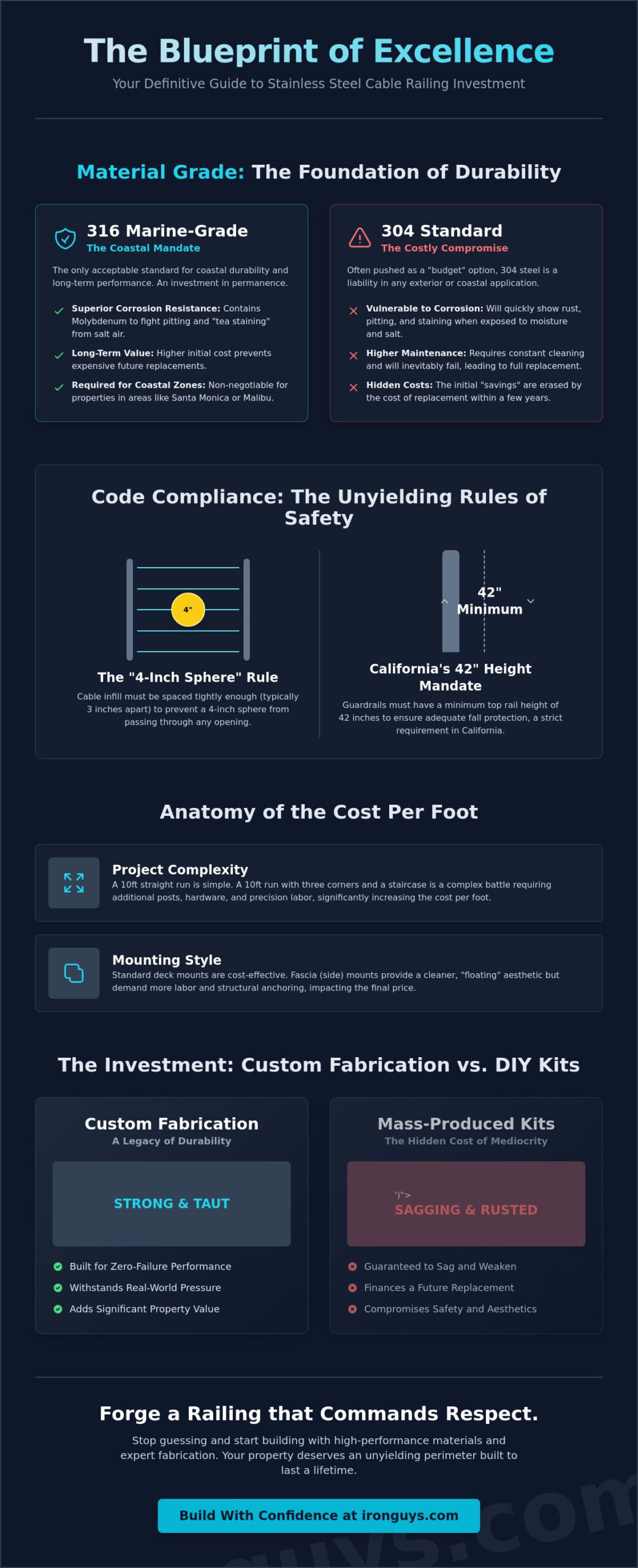
Most contractors will push 304 stainless steel because it’s cheaper and easier to source. In a controlled indoor environment, it might survive. Put it near the Pacific, and it will bleed. Type 316 Stainless Steel is the only acceptable standard for coastal durability. It contains Molybdenum, a chemical warrior that prevents “tea staining” and deep-pitting corrosion. If you live in Santa Monica or Malibu, 316 isn’t an upgrade; it’s a requirement. The cost premium for this grade reflects its ability to withstand salt air that eats lesser metals alive. Choosing anything less is a surrender to the elements.
Infill density is your next battleground. To meet California building codes, your cables must be tight enough to prevent a 4-inch sphere from passing through. This usually means a cable every three inches. More cables mean more hardware, more drilling, and more tensioning labor. It drives the stainless steel cable railing cost per foot upward, but it ensures your perimeter is a legal, unyielding barrier. We don’t build suggestions; we build to code.
Engineering and Tensioning Hardware
Hardware is where the “budget” systems fall apart. You have two paths: hidden fittings or exposed hardware. Hidden fittings provide a clean, surgical aesthetic where the tensioning happens inside the post. It looks better, but it demands higher precision and more labor hours. Exposed hardware is honest and gritty, but it requires high-quality swaging to ensure the cable never slips. We recommend professional-grade cable railing installations because the tension required to keep a 42-inch guardrail rigid is immense. If your posts are thin-walled aluminum extrusions, they will bow. You need custom-fabricated steel posts to act as the anchors for your vision. Use intermediate stabilizer posts on long runs to prevent cable deflection. Strength is a system, not a single part.
The Aesthetic War: Cable Railing vs. The Alternatives
Choose your weapon. When you invest in your property, you’re either building a legacy or managing a liability. Traditional materials like wood and glass often come with hidden taxes that most contractors won’t mention. They focus on the upfront stainless steel cable railing cost per foot, but they ignore the long-term cost of mediocrity. Wood balusters are bulky. They act like a visual cage that cuts your sightlines and shrinks your space. Glass is a transparent wall that traps heat and demands a weekly cleaning schedule. Cable railing is different. It’s the surgical strike of architectural design.
Retail fencing is a temporary fix. It’s built for the masses, not for your specific site. Custom metalwork is forged for your project’s unique geometry. It handles the tension that retail kits can’t match. If you want a railing that doesn’t sag or rattle when the wind picks up, you choose custom. It’s the difference between a custom-tailored suit and something off a rack. One fits the mission; the other just fills the space. Demand excellence from your materials. Your property deserves a system that commands respect.
Cable vs. Glass: The Battle for the View
Glass railing is a part-time job. It’s a magnet for dust, fingerprints, and salt spray. In hot climates, glass turns your balcony into a greenhouse by blocking essential airflow. Cable systems allow the environment to breathe. They offer near-total transparency without the weight or the constant scrubbing. While glass looks elite in a showroom, cable remains elite in the real world. Structural weight is another factor. Heavy glass panels put immense stress on your deck’s skeleton. Cable is lightweight, high-tension, and follows the International Residential Code for safety without the bulk.
Cable vs. Wrought Iron: Modern vs. Traditional
Traditional wrought iron has its place, but Los Angeles architecture is moving toward the horizon. Horizontal lines command the modern eye. Powder-coated iron is a classic, but it eventually chips and requires a touch-up. Raw, high-grade stainless steel is a different beast. It doesn’t hide behind paint; it stands on its own merit. In 2026, the market value of a home depends on its ability to blend indoor and outdoor spaces. Cable railing facilitates this flow. It’s an aggressive upgrade that signals a commitment to modern standards. When you calculate the stainless steel cable railing cost per foot, remember that you aren’t just buying wire. You’re buying the view you paid for when you bought the property. Stop settling for traditional barriers that block your progress.
The Los Angeles Crucible: Local Codes and Coastal Realities
Los Angeles is a battlefield for structural integrity. Every hillside post and coastal balcony is a target for both the elements and the city inspectors. When you calculate the stainless steel cable railing cost per foot, you’re paying for the peace of mind that comes with a passed inspection. Hillside terrain adds a layer of complexity that humbles the unprepared. Anchoring into steep grades or structural retaining walls requires surgical engineering. You aren’t just buying metal; you’re buying a permit-ready fortress that won’t get red-tagged by the city.
Navigating the LA Building Code
The 4-inch sphere rule isn’t a suggestion. It’s a rigid mandate. Your cables must be under enough tension to refuse passage to a 4-inch ball at any point between the runs. LA inspectors don’t care about your aesthetic vision; they care about the 42-inch height requirement for drops over 30 inches. We don’t just meet code. We dominate it. Over-engineering is the only way to ensure your project isn’t shut down. Build it right the first time. If your system isn’t rigid, it’s a liability.
Coastal Defense: Surviving the Salt Spray
Salt air accelerates corrosion on sub-par metals by introducing chloride ions that aggressively break down the protective oxide layer. If your project is within five miles of the Pacific, 304 stainless is a death sentence. Santa Monica and Malibu demand 316-grade stainless steel. We reinforce this with passivation and electropolishing to create a surface that’s virtually impenetrable to oxidation. This level of protection influences the stainless steel cable railing cost per foot, but it’s the only way to survive the relentless salt spray. Consult with the Iron Guys to ensure your coastal defense is impenetrable and built to last.
The Iron Guys Standard: Why Custom Fabrication Wins
Stop hunting for the lowest bid. It’s a race to the bottom that ends in a sagging, rusted mess. When you evaluate the stainless steel cable railing cost per foot, you are choosing between a temporary kit and a permanent legacy. National chains rely on subcontractors and mass-produced extrusions. We rely on the forge. Our team controls every weld, every tensioner, and every post right here in Los Angeles. We are the architects of your security. We don’t just install; we engineer. This is the Iron Guys standard. Precision is non-negotiable. We build for the long haul.
By eliminating the middleman, we ensure that the stainless steel cable railing cost per foot you pay goes directly into the quality of the 316-grade steel and the precision of the labor. There are no retail markups. There are no hidden fees for national logistics. It’s just raw material, high-intensity work, and a finished product that stands as a silent teacher of what excellence looks like. This is the crucible where your vision becomes a reality. We don’t offer excuses; we offer results that command respect from every neighbor and city inspector.
Bespoke Engineering for Your Property
Kits are for hobbyists. Your property is a high-performance environment. Generic fasteners rattle. They loosen under the vibration of the city. We use welded connections that turn your railing into a single, monolithic unit. This structural integrity is what separates an Iron Guys project from a weekend DIY attempt. We handle the radius curves and the aggressive hillside transitions that leave kits in the dust. Every angle is measured. Every post is anchored with the intent to outlast the structure it sits on. Stop settling for average—get an Iron Guys quote today.
The Elite Connection: Security and Style
Your perimeter is a statement. Don’t let it be a weak one. We specialize in integrated design. This means your balcony railings, security fences, and automatic gates all speak the same language of strength. It takes character to invest in the best. Most will take the shortcut. You are here because you demand more. Our local artisans and blacksmiths don’t just work with metal; they master it. We provide the elite connection between security and style. Your home deserves a unified defense that withstands the Los Angeles climate and commands absolute respect. Every foot of cable we pull is a testament to that commitment. Choose the path of discipline. Choose the Iron Guys.
Secure Your Vision with Uncompromising Strength
You now possess the intelligence to make a decisive move. Mediocrity is the primary enemy of your property’s potential. You’ve seen how the stainless steel cable railing cost per foot reflects the massive gap between a temporary fix and a permanent architectural statement. Don’t compromise on 316-grade marine stainless steel. Don’t gamble with the strict LA building codes that punish the unprepared. We’ve spent decades identifying the weaknesses in off-the-shelf products and replacing them with forged excellence. Build it right. Build it once.
Since 1998, our team has defined the standard for local Los Angeles fabrication and installation. We specialize in 316-grade materials that refuse to surrender to the salt air or the passage of time. It’s time to move from a state of complacency to one of decisive action. Choose the path of discipline and structural integrity. Build a perimeter that commands respect and enhances your property’s value without the constant maintenance tax. Forge your legacy—Request a custom cable railing quote from Iron Guys. Your vision is the blueprint; our craft is the execution. Stand tall behind a railing built to endure.
Frequently Asked Questions
Is stainless steel cable railing safe for homes with children and pets?
Safety is the only standard that matters. Cable railing is an impenetrable barrier when engineered correctly and tensioned to meet the 4-inch sphere rule. This mandate ensures that no child or pet can slip through the infill. We build systems that refuse to deflect under pressure. You aren’t just installing a view; you’re forging a rigid safety perimeter that protects your family without compromise.
Does cable railing rust if I live near the ocean in Los Angeles?
Cheap metal surrender to the salt. If you use 304-grade steel in Santa Monica or Malibu, it will pit and rust within months. You must use 316-grade marine stainless steel to survive the coastal crucible. This grade contains Molybdenum to fight off “tea staining” and deep corrosion. We don’t settle for inland materials when the Pacific is your backyard. Excellence requires the right alloy.
How often do I need to tighten the cables on my railing system?
Precision installations require almost zero maintenance. A professional system should be checked once after the first change of seasons to account for initial settling. After that, high-quality swaging and heavy-duty posts keep the tension locked. If you find yourself tightening cables every month, you bought a weak system. Demand custom fabrication that stays rigid and commands respect year after year.
Will cable railing pass a building inspection in California?
California inspectors are relentless and they follow the rules to the letter. Your railing will pass if it maintains a 42-inch height and prevents a 4-inch sphere from passing through the cables under load. We over-engineer every run to ensure you never face a red tag. Don’t gamble with your permit. Build to the highest standard and the inspection becomes a formality rather than a fight.
Can I install cable railing myself using a kit from a retail store?
You can try, but mediocrity is a heavy price to pay. Retail kits rely on thin-walled posts and mechanical fasteners that rattle and fail under real tension. We don’t sell or recommend mass-produced products because they lack the structural integrity required for a permanent legacy. A DIY attempt often results in sagging lines and wasted capital. Forge a professional result by choosing custom fabrication from the start.
What is the difference between 304 and 316 stainless steel for railings?
Type 316 contains Molybdenum, a chemical warrior that defends against chloride pitting in coastal environments. Type 304 is for inland territory where the air is dry and forgiving. If you’re calculating the stainless steel cable railing cost per foot, understand that 316 is a mandatory investment for Los Angeles. Choosing 304 near the beach is a choice to let your railing rot. Invest in the survivor.
How many cables do I need per post to meet safety codes?
Plan for 11 to 12 cable runs on a standard 42-inch guardrail. This density ensures you maintain the 3-inch spacing required to pass the 4-inch sphere test even when the cables are stressed. Every run adds to the hardware count and the labor of tensioning. This factor directly impacts the stainless steel cable railing cost per foot, but cutting a single run turns your safety barrier into a legal liability.
Does cable railing require a top rail or can it be ‘frameless’?
Code mandates a structural top rail for a reason. The top rail acts as the backbone that resists the immense inward pull of tensioned cables. Without a rigid top rail, your end posts will bow and the system will collapse. It also provides the graspable surface required by safety regulations. We forge top rails from steel or high-density wood to ensure your system remains a monolithic force of strength.